Cancer Treatment in India from Nepal: A Guide for Nepali Patients and Families
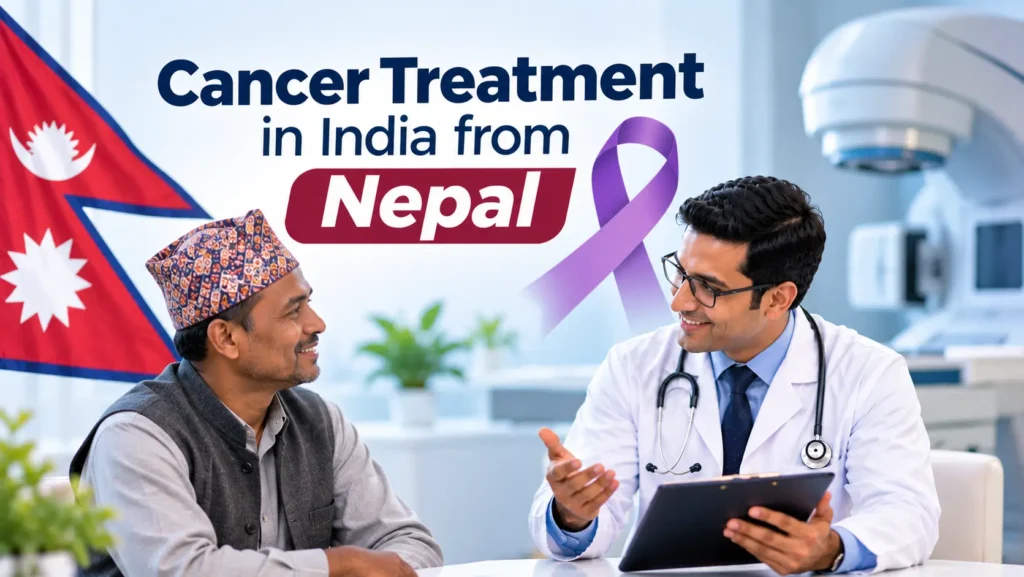
Cancer treatment in India from Nepal is a decision many Nepali families face, and it is easier to make with clear facts in hand. At Medicsaz, we have supported more than 3,000 international patients, we work with major hospitals in Delhi NCR, and we provide Nepali-speaking translators. This guide covers the cancers that are most common in Nepal, how to get an opinion, getting to Delhi, the hospitals we work with, cost ranges, and how to plan follow-up care at home. For the wider journey, including ID, money and accommodation, read our complete guide to medical treatment in India from Nepal.
Every cancer is different, and only your oncologist can decide the right plan for you after diagnosis and staging. Nothing in this guide replaces that advice.
Get Free Consultation Now
Why Nepali Families Consider India for Cancer Care
Cancer treatment is available in Nepal, including at the national cancer hospitals in Bhaktapur and Bharatpur. A 2025 study counts 13 public hospitals and 18 private hospitals or medical colleges that provide cancer treatment. Even so, Nepal News reported in January 2026 that most Nepali patients who travel to India for treatment are cancer patients, and a hospital representative estimated that about 600 Nepalis reach Delhi each day for treatment. A Nepali cancer specialist quoted in the same report said services have improved but many families still lack confidence that a cancer can be accurately diagnosed and treated at home. Families also mention long waits for chemotherapy and tests.
That is why a second opinion is often the sensible first step. It can confirm the diagnosis, the stage and the treatment plan, and it helps you decide where to be treated. India is not the right choice for every patient. Your own oncologist is the best person to discuss it with.
Cancers Most Common in Nepal
The Global Cancer Observatory estimates 24,499 new cancer cases in Nepal in 2024. The table lists the ten most common cancer, with our treatment page for each.
Cancer | Estimated new cases in Nepal, 2024 | Our page |
|---|---|---|
Stomach | 3,159 | |
Oesophagus | 2,069 | |
Breast | 1,746 | |
Liver | 1,623 | |
Cervix | 1,532 | |
Lung | 1,477 | |
Lip and oral cavity | 1,369 | |
Colorectum | 1,242 | |
Gallbladder | 1,073 | |
Ovary | 904 |
These are modelled estimates, and the Global Cancer Observatory notes that they rely on incidence data from neighbouring countries. Treat them as a guide to the pattern, not an exact count. We also cover head and neck cancer and blood cancer, including bone marrow transplant.
Getting an Opinion First
A good opinion needs complete records: your biopsy or histopathology report, the original scan reports and, where possible, the scan images on disc, your blood tests, any surgery or chemotherapy notes, and a list of your current medicines. When you send what you have, we check what is missing and tell you exactly what to get, so nothing delays your review. If a second pathology review is needed, we tell you whether the biopsy slides or tissue blocks are required, so you know what to request from the lab. Doctors may ask for extra tests to confirm the diagnosis and the stage before they recommend a plan. Do not delay urgent treatment while you wait for an opinion, and talk to your own doctor about timing.
Getting to Delhi
Nepali citizens entering India directly from Nepal need no visa, but must carry valid ID. Our complete guide for Nepali patients covers the ID details, the open-border rules and flights from Kathmandu. Many families travel by road or train, and a Nepal News report notes that for people in far-western Nepal, Delhi can be closer than Kathmandu. If you are weak or in pain, your doctor can advise whether a long road journey is safe, and we can plan your arrival around your appointment dates once you tell us how and when you will travel. Keep your original reports, scans and medicines with you at all times, and share your expected arrival time so our team and the hospital are ready for you.
From Diagnosis to Follow-Up: Cancer Treatment in India from Nepal
- Review the diagnosis: The hospital’s pathologists and oncologists review your biopsy report and, where possible, your slides, and may repeat or add tests to confirm the type of cancer.
- Stage the cancer: Scans and blood tests show how far the cancer has spread, which shapes the treatment plan.
- Agree the plan: For many cancers, and especially complex ones, the team discusses your case across specialities, such as surgery, medical oncology and radiotherapy, before recommending a plan and giving you a written estimate.
- Treat: Treatment follows the plan you agreed, which may include surgery, chemotherapy, radiotherapy or other therapy, in the order your team advises. Some cancers need several of these over weeks or months.
- Recover and review: Early check-ups show how you are responding and manage side effects, and the team decides when it is safe to travel home.
- Plan your follow-up: Before you leave, agree a written follow-up schedule and decide which parts can be done in Nepal.
Treatment Options Your Oncologist May Discuss
The plan depends on the type of cancer, its stage, your overall health and your preferences. It may include surgery to remove the tumour, chemotherapy, radiotherapy, targeted therapy or immunotherapy, or a combination. Some blood cancers are treated with a bone marrow transplant. Doctors also use imaging such as PET scans to stage some cancers. Your oncologist should explain the purpose of treatment, the expected benefits, the risks and the alternatives in plain language, and you are free to ask for a second opinion at any point.
Hospitals We Work With
These eleven Delhi NCR partner hospitals have oncology departments listed on their Medicsaz pages. The order of the list is not a ranking.
- Sarvodaya Hospital, Sector 8, Faridabad: medical, surgical and radiation oncology, haematology and bone marrow transplant, and nuclear medicine, with a Versa HD LINAC and 4D PET-CT; NABH accredited
- Fortis Hospital, Greater Noida: medical and surgical oncology and clinical haematology
- Max Smart Super Speciality Hospital, Saket: medical, surgical and radiation oncology, with an Onco Day Care unit; NABH accreditation listed by Max Healthcare
- Artemis Hospital, Gurgaon: medical, surgical and radiation oncology, hematology and a bone marrow transplant unit; JCI and NABH accredited
- BLK-Max Super Speciality Hospital: medical, surgical and radiation oncology, plus a bone marrow transplant centre; JCI, NABH and NABL accredited
- Dharamshila Narayana Superspeciality Hospital: medical, surgical and radiation oncology, plus bone marrow transplant; NABH accredited
- Indraprastha Apollo Hospital: medical, surgical and radiation oncology alongside other specialities; JCI accredited
- Manipal Multi-Speciality Hospital, Dwarka: medical, surgical and radiation oncology; NABH accredited
- Marengo Asia Hospitals, Faridabad: medical, surgical and radiation oncology, hematology and bone marrow transplant support; NABH and NABL accredited
- Max Super Speciality Hospital, Saket: medical, surgical and radiation oncology; JCI accredited
- Medanta Multi-Speciality Hospital, Noida: medical and surgical oncology, blood cancer care and bone marrow transplant, with CAR-T cell therapy and robotic surgery available
We match your diagnosis to the hospital and doctor who treat your condition regularly. See all our partner hospitals and our doctors.
Cancer Treatment Costs in India: Planning Ranges
Cancer treatment costs vary more than almost any other area of care. They depend on the type of cancer, the stage, the treatment plan, the hospital and the length of stay. The ranges below come from published international-patient price guides, checked in November 2026. They are planning figures, not quotations, and surgery, chemotherapy and radiotherapy are priced separately.
Treatment | Typical range in India (USD) |
|---|---|
Breast cancer: mastectomy | $3,000 – $6,500 |
Stomach cancer: gastrectomy, Delhi NCR | $6,100 – $9,200 |
Rectom cancer | $6,000 – $8,000 |
Radiotherapy, one course | $3,500 – $7,900 |
Chemotherapy, per cycle | $500 – $2,000 |
$5,600 – $8,500 |
Targeted therapy and immunotherapy can cost considerably more than standard chemotherapy, and complications or a longer stay add to the total. Nepal News reported that a PET scan costs about 20,000 Indian rupees in India, about 32,000 Nepali rupees, against about 70,000 Nepali rupees in Nepal, but prices differ between centres. If an estimate is in Indian rupees, multiply it by 1.6 to convert it to Nepali rupees. Flights or road travel, accommodation, food and local transport for you and your attendant are separate from the hospital bill, and they add up over a long course of treatment. We obtain a written estimate from each hospital that states the currency and the expected duration, and we explain what it includes and excludes.
Want an estimate for your own case? Send your reports to Medicsaz for a free medical opinion. We provide a free cost estimate to patients who are planning treatment in India.
Follow-Up Care: What Can Be Done in Nepal
Cancer care continues long after the main treatment ends, and many families travel back and forth for check-ups. A Nepali cancer specialist told Nepal News that many patients do not realise some follow-up can be done in Nepal, and that doing so can save a large amount of money. What can safely be done at home depends on your cancer and your treatment. Before you leave, we ask your treating oncologist which follow-up visits, blood tests and scans can be done in Nepal and which need the team that treated you, and we write that into your follow-up plan. We also collect a written summary of your diagnosis, treatment and medicines, copies of your reports and scans, and a clear list of warning signs, and we arrange online follow-up consultations with your Indian team, so your oncologist in Nepal can continue your care with full information.
Common Doubts, Answered Honestly
Is my cancer too advanced to travel?
Only your doctors can judge that. We can send your reports to our partner hospitals’ oncologists, so you hear their view on travel before you decide. Do not delay urgent treatment while you explore options.
Should I start treatment in Nepal first?
That is a medical decision. Some families begin treatment at home and seek an opinion in parallel. We can share your current plan and reports with our partner hospitals and ask whether anything should wait for their opinion, so you do not repeat tests or stop treatment without medical advice.
Can someone promise a cure?
No. No honest hospital or facilitator can guarantee a result, and results vary from patient to patient. Be wary of anyone who promises a cure, pressures you to decide quickly, or asks you to pay into a personal account. Nepal News reported that some Nepalis are cheated by agents when they travel for treatment. With Medicsaz you receive the hospital’s name and a written estimate, so you can check them yourself.
Conclusion
Cancer treatment in India from Nepal works best when it starts with a clear diagnosis, an opinion on complete records, and written plans and estimates you can compare before you travel. We help with each step: we check your records, bring back opinions from our partner hospitals that treat your type of cancer, and agree a follow-up plan with you, including what can be done in Nepal, before you leave. For the rest of the journey, see our complete guide to medical treatment in India from Nepal, or contact Medicsaz for a free medical opinion.
Frequently Asked Questions
How much does cancer treatment cost in India?
It varies widely. Planning ranges are in the cost section above, and your own estimate depends on your cancer, its stage and your treatment plan.
How do I choose a hospital for my cancer?
We do this with you. We share your reports with our partner hospitals, and their oncology teams tell us whether they treat your type of cancer regularly and can offer the treatments your plan needs. Three things matter most: how often the team treats your cancer, whether surgery, chemotherapy and radiotherapy are available in one place, and whether specialists review complex cases together. We bring back the hospitals’ written opinions and estimates, along with their accreditation, so you can compare them and decide with your own doctor. If a hospital is not a good fit for your cancer, we tell you.
Can I continue follow-up care in Nepal?
Often some of it, depending on your cancer and treatment. We ask your treating oncologist which follow-up can be done at home and put it in your written follow-up plan.
Can anyone guarantee that treatment will work?
No. Every cancer and every patient is different, and no treatment can be guaranteed.
Medically Reviewed
This page has been medically reviewed by Dr. Rashid Ali, MBBS, a Delhi Medical Council–registered practitioner (Registration No. DMC/R/36289), to ensure it reflects accurate, current, and evidence-based medical information.
At Medicsaz, every treatment page is checked by a licensed doctor before publication, not written by a marketing team alone. Dr. Rashid Ali review covers the accuracy of procedures, terminology, and claims described on this page, so patients researching can rely on what they read here to make informed decisions.
Last medically reviewed: 05/11/2026
You can independently verify Dr. Rashid Ali’s registration on the Delhi Medical Council’s official website using Registration No. DMC/R/36289, or read more about his role as Medicsaz’s medical reviewer on his reviewer profile page.