
Why Middle East Patients Trust Indian Hospitals
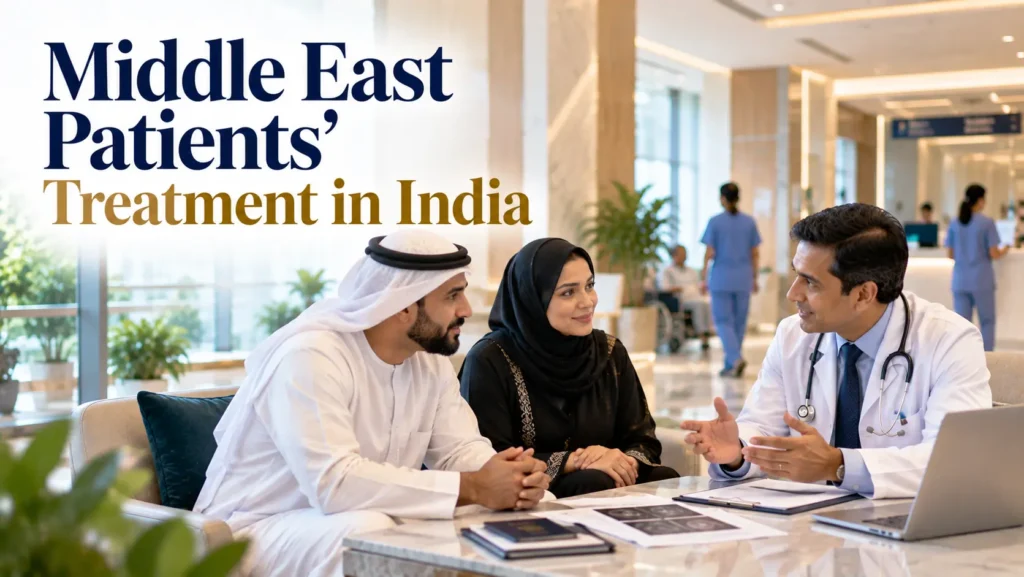
Having to manage such problems in one’s life, such as heart issues, complicated tumors, or joint damage, is a challenge for a person’s whole life. It gives great comfort to find such a place where there is immediate help, excellent surgical results, and good communication. Deciding to coordinate Middle East patients’ treatment in India ensures your family secures world-class medical outcomes within a realistic budget.
India has been a particularly popular destination for international medical tourism. Annually, there are thousands of patients visiting India from the UAE, Saudi Arabia, Oman, Kuwait, Qatar, Bahrain, and Iraq for special surgeries. The major driver of this trend is the world-class facilities and special programs offered to cater to foreign tourists.
Get Free Consultation Now
Why India Is a Preferred Healthcare Destination for Middle East Patients
Traveling abroad for a major surgery is a huge decision, but families consistently trust this route due to several core advantages:
- Doctors with massive volume: Senior surgical directors handle more complex operations in a single month than many Western clinics see all year.
- Shorter waiting delays for many procedures: Unlike public insurance lines in Europe, many elective procedures move quickly once you arrive, though organ transplants specifically still require donor legal verification and approval steps that take time regardless of arrival date.
- Full language assistance: Top corporate clinics provide full-time, fluent Arabic translators who stay by your side through every doctor consultation.
- Clear, transparent packages: Hospitals compile all-inclusive bundles so you can see your complete expenses upfront without surprise fees.
These key points make securing Middle East patients’ treatment in India an exceptionally smooth, safe, and predictable experience.
World-Class Hospitals and International Accreditations
There is no denying the fact that the success rate of Indian clinics nowadays can be attributed to their safety certifications recognized worldwide. Leading centers in large metropolises bear the seal of quality by having stringent JCI and NABH standards.
These certifications legally assure you that the center adheres to stringent criteria for maintaining a patient-safe environment during intricate surgeries, ultra-sterile rooms to prevent infections, and high-quality medical equipment recognized worldwide. Organizing a structured outline for Middle East patients’ treatment in India means your recovery takes place inside highly advanced multi-specialty wings built to run intensive care lines safely.
Experienced Doctors and Multidisciplinary Medical Teams
India houses some of the world’s most experienced medical specialists. Senior surgical directors frequently carry board certifications or fellowship training from elite universities in the US or UK.
Since these surgeons deal with a huge number of complex cases every year, their great accuracy results in higher success rates. Moreover, you will be treated by a team of specialists working together. Surgeons, radiologists, anesthesiologists, and physiotherapists will collaborate to find an effective treatment plan for all international patients.
Because of the collaborative approach taken by these specialized teams, the overall quality and efficiency of Middle East patients’ treatment in India are significantly enhanced.
Advanced Technology and Specialized Treatments
Advanced healthcare networks utilize state-of-the-art technology in their modern operating rooms in order to achieve high precision and shorten recovery time.
- Robotic Surgery Machines: The da Vinci system employs computer-controlled robotic arms for cutting tissues and implanting devices with sub-millimeter accuracy.
- Targeted Radiation Therapy: High-tech oncology centers employ non-invasive radiosurgery machines such as the CyberKnife or Gamma Knife for eradicating deep-seated cancerous tissues without damaging normal tissues.
- High-resolution Imaging: Modern hybrid surgery rooms employ 3D mapping and PET-CT scanning machines in order to monitor delicate blood vessels during surgeries.
| Medical Specialty | Common Advanced Treatments |
|---|---|
| Cardiology | Complex coronary heart bypass (CABG), robotic valve repairs, and pediatric heart corrections |
| Oncology | Complex tumor resections, targeted radiation, and modern immunotherapy lines |
| Orthopedics | Computer-navigated knee and hip replacements, and keyhole arthroscopic repairs |
| Organ Transplant | Advanced living-donor liver and kidney transplants, which require the donor to be a legally verified “near relative” (spouse, parent, child, sibling, or grandparent) and approval from a government Authorization Committee before surgery can proceed |
| Neurology | Intricate brain tumor surgery and minimally invasive spine fusions |
| Fertility | Advanced IVF treatments and specialized reproductive care protocols |
Having these advanced medical technologies under one roof ensures that the baseline quality of Middle East patients’ treatment in India remains completely uncompromised.
Affordable Healthcare Without Compromising Quality
The massive pricing gap between Western clinics and Indian multi-specialty hospitals is a permanent, structural reality. Families receive elite care using identical global device brands and FDA-approved drugs without facing crushing financial debts.
| Surgical Procedure Type | Average Cost in India (USD) | Average Cost in the USA (USD) |
|---|---|---|
| Heart Bypass Surgery | $4,500 – $8,500 | $100,000+ |
| Kidney Transplant | $7,000 – $15,000 | $250,000+ |
| Liver Transplant | $25,500 – $45,000 | $300,000+ |
| Knee Replacement | $4,500 – $8,000 | $35,000+ |
Choosing to handle Middle East patients’ treatment in India helps families save anywhere from roughly 75% up to more than 90% on standard medical billing lists, depending on the specific procedure, while receiving care from world-renowned doctors.
Language Support and Personalized Patient Services
The presence of full-time international patient departments ensures that foreign families never face logistical stress or communication barriers in a new country.
- Arabic-Speaking Interpreters: Fluent liaisons assist you with everything from initial case reviews to daily ward updates.
- Personalized Care Planning: Dedicated case managers build your exact daily routine around your unique medical history.
- Custom Dietary Options: In-house nutritionists curate fresh, culturally familiar Halal meals to support your recovery inside the ward.
- 24/7 Patient Assistance: On-ground teams look after your immediate questions, local SIM cards, and basic family needs around the clock.
Medical Visa, Travel, and Accommodation Assistance
The Indian government has ensured smooth cross-border relations with its unique “Heal in India” program, making your journey extremely hassle-free.
- Support for Medical Visa: The moment you submit your scans to them online, the hospitals issue Visa Invitation Letters (VIL) for your e-Medical visa application in just 48 to 72 hours.
- Airport Pickup Service: Free of charge, cars or specially equipped intensive care ambulances pick up your loved one straight from the arrivals aerobridge.
- Hospital Local Stay Facility: The international department ensures that your relative gets serviced apartments that are cleaned and sterile, and have their own kitchens close to the hospital premises.
- Prior Scheduling: They make all arrangements, including your scan reports, laboratory tests, and surgical appointments in advance.
Success Stories and Patient Outcomes
Each year sees numerous families hailing from the Gulf region sharing heart-warming success stories after overcoming serious health challenges through successful treatment at the hands of surgeons and nurses in India. The good experiences reported by patients can be attributed to the quality of surgery conducted and the excellent pre- and post-surgery care provided by the nursing personnel.
Planning Your Medical Journey from the Middle East
- Send Medical Records Ahead: Send emails with your current X-Rays, MRIs, and biopsies to the international department prior to your visit for an exact pre-arrival map.
- Get Your Medical Visa: Always be sure to get a Medical Visa (MED). The hospitals do not have the right to admit people traveling on tourist visas.
- Make Room for Additional Expenses: Take into account costs such as traveling locally, meal expenses, lodging, and medication that can last several months and are cheap.
- Come Along With a Buddy: It will help you have somebody who can look after you emotionally and physically during your recovery process.
Conclusion
India has built a prominent name for global healthcare by mixing internationally certified surgical talent, modern robotic tools, and compassionate, patient-first care. Planning Middle East patients’ treatment in India provides families with a legal, safe, and highly successful pathway to handle tough diagnoses. By working transparently with certified coordination desks, preparing your medical binders early, and planning your post-op rest days correctly, you can safely wash away financial anxiety and look forward to a healthy, independent future.
Frequently Asked Questions
Can any relative or friend act as a living donor for a Middle Eastern patient needing a transplant in India?
No. Indian law requires the donor to be a verified “near relative”: a spouse, parent, child, sibling, or grandparent. The relationship must be documented and, in the case of unrelated donors, approved by a government Authorization Committee before surgery can proceed.
Will I really get surgery dates immediately upon arrival, even for a transplant?
For many elective procedures, scheduling is often faster than in insurance-based systems abroad. Organ transplants are the exception, since donor verification and legal approval steps take time regardless of when you arrive.
How much can I realistically expect to save compared to treatment in the US?
Savings vary by procedure but commonly range from about 75% up to more than 90%, with transplants and heart surgery often showing the highest percentage savings. Request an itemized quote for your specific procedure to get an accurate figure.
Is halal food guaranteed to be available during my hospital stay?
Many hospitals catering to Gulf and Middle Eastern patients do offer halal meal options through in-house nutritionists, but it’s worth confirming this directly with your chosen hospital’s international desk before traveling.
How quickly can I get a medical visa invitation letter once I submit my records?
Hospitals typically aim to issue the Visa Invitation Letter within 48 to 72 hours of reviewing your scans, though actual visa approval timing also depends on your nationality and the current embassy workload.
What should I budget for beyond the quoted treatment cost?
Plan for local transportation, meals, accommodation, and a multi-month supply of affordable medication; these add to your total cost beyond the base treatment package price.
Medically Reviewed
This page has been medically reviewed by Dr. Rashid Ali, MBBS, a Delhi Medical Council–registered practitioner (Registration No. DMC/R/36289), to ensure it reflects accurate, current, and evidence-based medical information.
At Medicsaz, every treatment page is checked by a licensed doctor before publication, not written by a marketing team alone. Dr. Rashid Ali review covers the accuracy of procedures, terminology, and claims described on this page, so patients researching can rely on what they read here to make informed decisions.
Last medically reviewed: 09/09/2026
You can independently verify Dr. Rashid Ali’s registration on the Delhi Medical Council’s official website using Registration No. DMC/R/36289, or read more about his role as Medicsaz’s medical reviewer on his reviewer profile page.