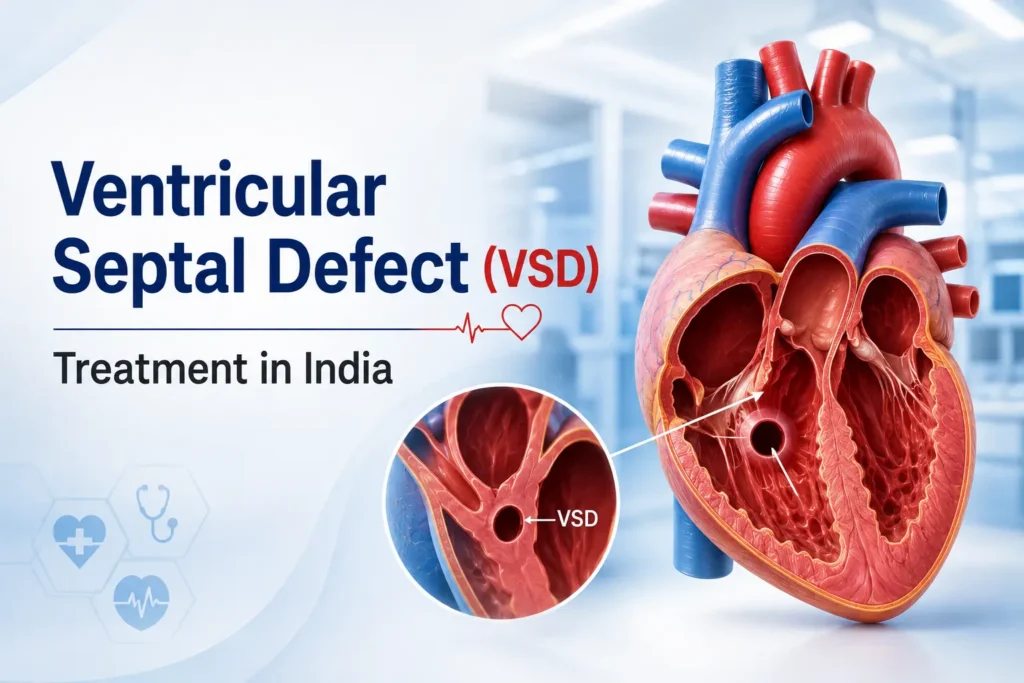
Ventricular Septal Defect (VSD) Treatment in India
Some types of heart diseases are present right from the time of birth but remain undiagnosed for quite some time. Many times, the symptoms are difficult to detect until the heart starts working much harder and becomes evident over time. The problems are not detected because of symptoms such as rapid breathing and weight loss.
One common congenital heart disease is the Ventricular Septal Defect (VSD). It occurs when there is a hole in the partition between the ventricles, affecting the normal flow of blood. Today, Ventricular Septal Defect (VSD) Treatment in India uses advanced imaging tools and modern clinical care to help children recover and grow properly.
Get Free Consultation Now
What is a Ventricular Septal Defect (VSD)?
A ventricular septal defect refers to a hole between the walls that separate the two lower chambers of the heart. Due to this hole, oxygenated and deoxygenated blood mix together inside the heart. The result is extra pressure on the heart and lungs, and the heart works harder than it should. While smaller holes tend to seal themselves over time, larger holes need to be treated.
Symptoms of VSD in Babies and Children
The severity of symptoms is primarily linked to the size of the defect and the amount of leakage. Typical indicators include rapid or labored breathing, particularly during feeding. Infants might experience difficulty gaining weight or suffer from recurrent respiratory infections. In less severe cases, symptoms may be very subtle, or there may be no apparent issues at all.
Causes of Ventricular Septal Defect
VSD is a congenital condition, meaning it happens before birth while the baby’s heart is still forming. The exact cause is not always known. In some cases, genetic factors or other heart abnormalities may be involved. It is never caused by anything the child does after birth.
Types of VSD Explained
Ventricular septal defects come in various forms based on the position of the defect within the walls of the heart.
- Perimembranous VSD is the most common form of ventricular septal defect.
- A muscular VSD is situated in the muscular section of the septum.
- An inlet and an outlet VSD are located near the valves and arteries.
Position and size influence how best to treat the condition. Muscular VSD and selected cases of perimembranous VSDs that have anatomically favorable features can undergo device closure. The inlet and outlet VSDs and the perimembranous VSDs located near the valves would need surgical correction.
How VSD Is Diagnosed in India
Doctors usually suspect a VSD after hearing an abnormal heart sound during a check-up. To confirm the diagnosis, they use several imaging tools:
- Echocardiography (Echo): This is the main test used to view the hole in the heart.
- ECG: This checks the electrical activity and rhythm of the heart.
- Chest X-ray: This evaluates heart size and the condition of the lungs.
- Pulse Oximetry: This measures the oxygen levels in the blood.
Treatment Options for VSD in India
Treatment depends on the size of the defect and how the heart is functioning. Small VSDs might only need regular monitoring, since they can sometimes close on their own over time. Larger defects that affect heart function usually need active treatment. Options include medication to reduce strain on the heart, device closure, or open heart surgery.
VSD Closure Surgery and Device Treatment
A device closure procedure involves sending a catheter into the heart through a blood vessel. Once there, a device that closes off the hole is placed into the heart in order to prevent abnormal blood flow through the heart. The procedure is commonly employed for cases of muscular VSD and certain perimembranous cases. If the ventricular septal defect is large or more complex, an open-heart surgery procedure may be necessary. During this procedure, the hole is closed either with stitches or a patch.
Both procedures carry the risk of interfering with the electrical system in the heart, causing an irregular heartbeat, and in rare instances, heart block, which necessitates the use of a pacemaker.
Recovery After VSD Treatment
Recovery speed depends on the type of treatment performed. After a device closure, children usually recover quickly and go home within a few days. Surgical recovery takes longer and might require several weeks for full healing. Doctors always advise regular follow-up visits to confirm the treatment is working well.
Risks and Complications of Ventricular Septal Defect (VSD) Treatment
Ventricular Septal Defect (VSD) procedures are relatively risk-free, although no surgery on the heart can ever be without risks. These include the possibilities of bleeding, infection, or even electrical disturbances in the rhythm of the heart, with a remote possibility of developing total heart block requiring pacemaker insertion. Occasionally, there may be a minor leakage around the surgical site. Modern-day methods have significantly reduced these risks.
Long-Term Heart Care After VSD Closure
Although the condition has been corrected effectively, the patient must still undergo routine check-ups to monitor heart function and development. Most children who require surgery for VSD do not have restrictions for sports or school once they’ve recovered, and most patients go on to lead active and normal lives after successful treatment.
Ventricular Septal Defect (VSD) Treatment in India Cost
Ventricular Septal Defect (VSD) Treatment in India typically costs around $3,500 to $9,000, depending on the type and size of the defect, treatment approach, hospital, and the patient’s medical requirements. Device closure and surgical repair are the main treatment options for suitable patients, while complex or minimally invasive procedures may cost more.
The exact cost depends on the VSD’s size and location, patient’s age and overall condition, type of closure, device or surgical materials, cardiologist and cardiac surgeon, preoperative investigations, anesthesia, ICU and hospital stay, medications, and postoperative care. Complex defects, additional cardiac conditions, prolonged hospitalization, or treatment-related complications may further increase the overall cost. These figures are general estimates, not fixed quotes. Medicsaz can provide a personalized estimate after a partner pediatric or adult cardiologist and cardiac surgeon review the patient’s medical records and treatment requirements.
How Medicsaz Supports Your Ventricular Septal Defect (VSD) Treatment in India Journey
Medicsaz connects international patients with vetted partner hospitals and experienced cardiologists, pediatric cardiologists, and cardiac surgeons for Ventricular Septal Defect (VSD) Treatment in India. The team assists with medical record review, hospital and specialist matching, treatment and cost estimates, travel and visa support, accommodation, and coordination throughout the patient’s treatment journey.
For patients exploring Ventricular Septal Defect (VSD) Treatment in India, Medicsaz can help identify an appropriate cardiac specialist and treatment approach based on the patient’s medical records, VSD type, age, anatomy, and clinical requirements.
Conclusion
A ventricular septal defect is a common heart problem, but early diagnosis leads to very positive outcomes. Ventricular Septal Defect (VSD) Treatment in India provides advanced care and modern options for both children and adults. With timely treatment and long-term follow-up, many patients lead healthy and active lives.
Frequently Asked Questions
Will my child's VSD close on its own without treatment?
Many small VSDs close naturally as a child grows and may never need treatment. Larger VSDs are less likely to close on their own and usually require monitoring or active treatment.
Is device closure or surgery better for a VSD?
It depends on the type, size, and location of the defect. Device closure is generally used for muscular VSDs and select perimembranous cases, while inlet, outlet, and some perimembranous VSDs typically require surgical repair. Your cardiologist will recommend the right approach for your child’s specific anatomy.
Can a child play sports after VSD treatment?
Most children who’ve had a VSD successfully treated, whether by device or surgery, have no long-term restrictions on sports or physical activity once they’ve fully recovered.
What are the risks of VSD closure?
Risks include bleeding, infection, and changes in heart rhythm. A rare but serious risk is complete heart block, which can require a permanent pacemaker, particularly with perimembranous VSD closure.
How long does recovery take after VSD surgery or device closure?
Device closure typically allows children to go home within a few days. Surgical recovery generally takes a few weeks for full healing.
Will my child need lifelong follow-up after VSD treatment?
Yes, regular cardiology check-ups are recommended even after successful treatment to monitor heart function and development over time.
Medically Reviewed
This page on Ventricular Septal Defect (VSD) Treatment in India has been medically reviewed by Dr. Rashid Ali, MBBS, a Delhi Medical Council–registered practitioner (Registration No. DMC/R/36289), to ensure it reflects accurate, current, and evidence-based medical information.
At Medicsaz, every treatment page is checked by a licensed doctor before publication, not written by a marketing team alone. Dr. Rashid Ali review covers the accuracy of procedures, terminology, and claims described on this page, so patients researching Ventricular Septal Defect (VSD) Treatment in India can rely on what they read here to make informed decisions.
Last medically reviewed: 09/09/2026
You can independently verify Dr. Rashid Ali’s registration on the Delhi Medical Council’s official website using Registration No. DMC/R/36289, or read more about his role as Medicsaz’s medical reviewer on his reviewer profile page.