
Shoulder Replacement Surgery in India
That dull ache in your shoulder, the one you’ve been ignoring for months now, probably started so gradually you can’t even pinpoint when exactly it became a daily companion. Most people assume it’s nothing serious, maybe slept weird, maybe overdid it at work, surely it’ll disappear on its own eventually. Except sometimes it doesn’t disappear; sometimes it gets worse.
Patients are seen who waited years before finally admitting something was genuinely wrong inside their joint. Shoulder replacement surgery in India isn’t some rare experimental procedure anymore; surgeons here perform thousands yearly, implants have gotten sophisticated, and outcomes rival anywhere else globally. But accepting that your shoulder needs replacing, that mental journey takes most people considerable time.
Get Free Consultation Now
What Is Shoulder Replacement Surgery?
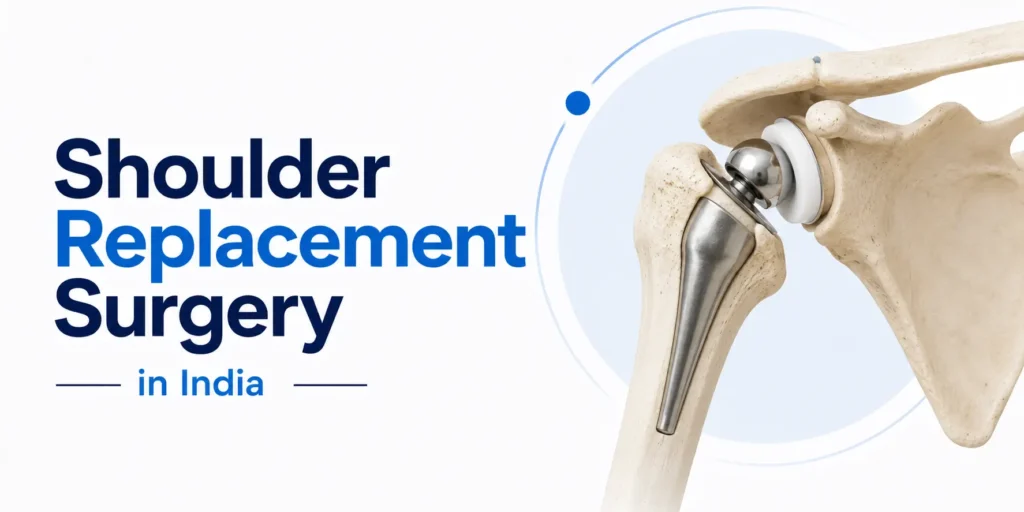
Your shoulder works like a ball sitting in a shallow cup. The upper arm bone has this rounded head fitting into a socket on your shoulder blade, and cartilage keeps everything gliding smoothly. Normally, you never think twice about reaching overhead or hugging someone tightly, but cartilage breakdown ruins everything.
When shoulder cartilage wears out from arthritis or an old injury, bone on bone friction causes severe pain, sometimes even with simple movements like reaching for a glass or getting dressed. Replacement surgery involves swapping damaged surfaces with artificial parts. Modern implants typically last 15 to 20 years.
Who Needs Shoulder Replacement Surgery?
Here’s where some doctors and patients disagree, and I’ll be honest about this. Some surgeons recommend surgery perhaps sooner than necessary, while others wait so long that patients suffer needlessly for extra months.
Surgery makes sense when you’ve genuinely exhausted other options. physiotherapy didn’t help despite proper time, medications stopped working, or your stomach can’t handle them, injections provided temporary relief, but pain returned worse each time. What pushes most people toward finally agreeing? Usually, sleep deprivation. When you haven’t slept properly in six months because every position hurts and you’re exhausted constantly, suddenly surgery doesn’t seem scary compared to continuing indefinitely.
Causes of Shoulder Joint Damage
Osteoarthritis accounts for most cases, honestly, gradual wear and tear accumulating over decades until cartilage simply gives out, commonly noticed in people above fifty, though younger patients with severe damage exist, depending on history.
Rheumatoid arthritis is nastier because your own immune system attacks the joint lining, causing damage even if you’ve been careful your entire life. Old injuries surprisingly trigger arthritis ten or fifteen years after the original fractures apparently healed completely. Rotator cuff tears never properly addressed throw off entire joint mechanics, wearing things down faster than normal aging would.
Types of Shoulder Replacement Surgery in India
Depending on what’s damaged and whether your rotator cuff functions properly, surgeons choose between different approaches:
- Total replacement swaps both ball and socket with artificial components, working best when rotator cuff tendons remain healthy enough to support new parts.
- Partial replacement addresses only the ball portion, leaving the natural socket intact when socket damage remains minimal.
- Reverse replacement flips the arrangement entirely, placing the ball where the socket belongs and vice versa, a solution for patients whose rotator cuff is too damaged to support traditional implants.
Shoulder Replacement Surgery Procedure
Before cutting happens, you’ll go through extensive testing, blood work, heart evaluation, and scans showing exactly what surgeons encounter inside. Takes time, but skipping preparation creates unnecessary risks nobody wants.
Surgery typically runs two to three hours; you’re completely under anesthesia, feeling nothing, and afterward you wake up with your arm immobilized in a sling, becoming your constant companion for several weeks. The surgeon removes damaged bone surfaces, prepares what remains, positions artificial components precisely where they belong, and then closes everything up carefully.
Tests Before Shoulder Replacement Surgery in India
Pre-surgery clearance is required to ensure safety:
- Lab work: Blood tests check for and address infections, anemia, and clotting issues.
- Imaging: Chest X-rays and ECG confirm heart and lung function for anesthesia. Shoulder X-rays and CT or MRI determine the extent for surgical planning.
- Medication Review: Identify drugs needing temporary discontinuation.
Final clearance is given once all checks are complete and chronic conditions are controlled before the surgery date.
Recovery After Shoulder Replacement Surgery
Can I be direct about something? Surgery itself is the easy part in a sense. you’re asleep, the surgeon works, you wake up, and it’s done. Recovery determines outcomes through your effort and consistency.
Hospital stay typically runs two to four days, depending on the hospital’s protocol, while they monitor pain levels and watch for complications. That sling stays on for weeks, frustrating but necessary. Significant pain reduction is usually noticed within the first week, though complete healing takes months. You will get specific instructions on wound care, sleeping, movements to avoid, and warning signs needing immediate medical attention.
Life After Shoulder Replacement Surgery
That constant pain dominating your existence fades, activities you’d abandoned become possible again, and sleep returns to normal. Your mood improves because chronic pain affects mental health more than people acknowledge openly.
Permanently avoid heavy lifting and high impact activities. Swimming, walking, golf, and daily tasks are fine. Annual or biennial checkups are necessary. Most patients’ new joints last 15 to 20 years, or more, with good care.
Shoulder Replacement Surgery Cost in India
Shoulder replacement surgery in India for international patients typically costs between $6,500 and $9,000, covering the surgery itself, implant, hospital stay, anesthesia, and standard post-operative care. More complex cases, a reverse shoulder replacement, for instance, or surgery complicated by a prior injury, tend to sit toward the higher end of that range.
What actually moves the number: which hospital and city you choose, the type of implant used, and how many days you need in hospital and recovering nearby. This is a general range, not a fixed quote. Medicsaz can put together a personalized cost estimate once a partner specialist has reviewed your case and imaging.
How Medicsaz Supports Your Shoulder Replacement Journey
Medicsaz connects you with vetted partner hospitals and orthopedic specialists experienced in shoulder replacement, and coordinates everything around the surgery itself, cost estimates, medical records review, hospital and doctor matching, travel and visa support, accommodation, and a point of contact throughout your stay in India. The goal is that the surgery is the only hard part; the logistics shouldn’t be.
If you’re ready to explore this, reach out for a free medical opinion and cost estimate. Most inquiries get a response within 30 minutes.
Conclusion
Living with severe shoulder pain changes your personality in ways you might not notice until afterward, when pain finally stops, and you remember what normal actually felt like. The constant discomfort affects sleep, patience, relationships, work capability, basically everything, making life enjoyable.
Shoulder replacement surgery in India has helped thousands escape that cycle and return to lives not defined by which movements they’re avoiding today. Recovery demands genuine effort, and the decision requires thought, but for those who have exhausted other options, this surgery consistently delivers results patients describe as worth the journey. If your shoulder pain is persistent and unresponsive to treatment, consult a specialist to inform your best decision.
Frequently Asked Questions
How do I know if I actually need shoulder replacement surgery, or if physiotherapy is enough?
If physiotherapy has been given a genuine, sustained try and pain still hasn’t improved, or medications and injections only offer temporary relief that keeps getting shorter, surgery becomes a reasonable next step. The clearest sign for most patients is disrupted sleep that hasn’t improved for months.
What's the difference between total, partial, and reverse shoulder replacement?
Total replacement swaps both the ball and socket and works best with a healthy rotator cuff. Partial replacement only replaces the ball, leaving the natural socket intact. Reverse replacement flips the ball and socket arrangement and is used specifically when the rotator cuff is too damaged to support a standard implant.
How long do I need to wear a sling after surgery?
Most patients wear a sling for several weeks after surgery to protect the joint while it stabilizes. Your surgeon will guide you on when it’s safe to start removing it for short periods.
How long does a shoulder replacement actually last?
Modern implants typically last 15 to 20 years, and with good care and low impact activity, some last even longer.
Can shoulder arthritis come back after surgery, or come back in the other shoulder?
The replaced joint itself won’t develop arthritis again since the damaged surfaces are gone, but the opposite shoulder can still develop arthritis independently if it has its own wear and tear.
What activities are off-limits after shoulder replacement?
Heavy lifting and high impact activities should be permanently avoided. Lower impact activities like swimming, walking, golf, and normal daily tasks are generally fine once you’ve healed.
Medically Reviewed
This page on Shoulder Replacement Surgery in India has been medically reviewed by Dr. Rashid Ali, MBBS, a Delhi Medical Council–registered practitioner (Registration No. DMC/R/36289), to ensure it reflects accurate, current, and evidence-based medical information.
At Medicsaz, every treatment page is checked by a licensed doctor before publication, not written by a marketing team alone. Dr. Rashid Ali review covers the accuracy of procedures, terminology, and claims described on this page, so patients researching Shoulder Replacement Surgery in India can rely on what they read here to make informed decisions.
Last medically reviewed: 09/09/2026
You can independently verify Dr. Rashid Ali’s registration on the Delhi Medical Council’s official website using Registration No. DMC/R/36289, or read more about his role as Medicsaz’s medical reviewer on his reviewer profile page.