
Nephrectomy Surgery in India
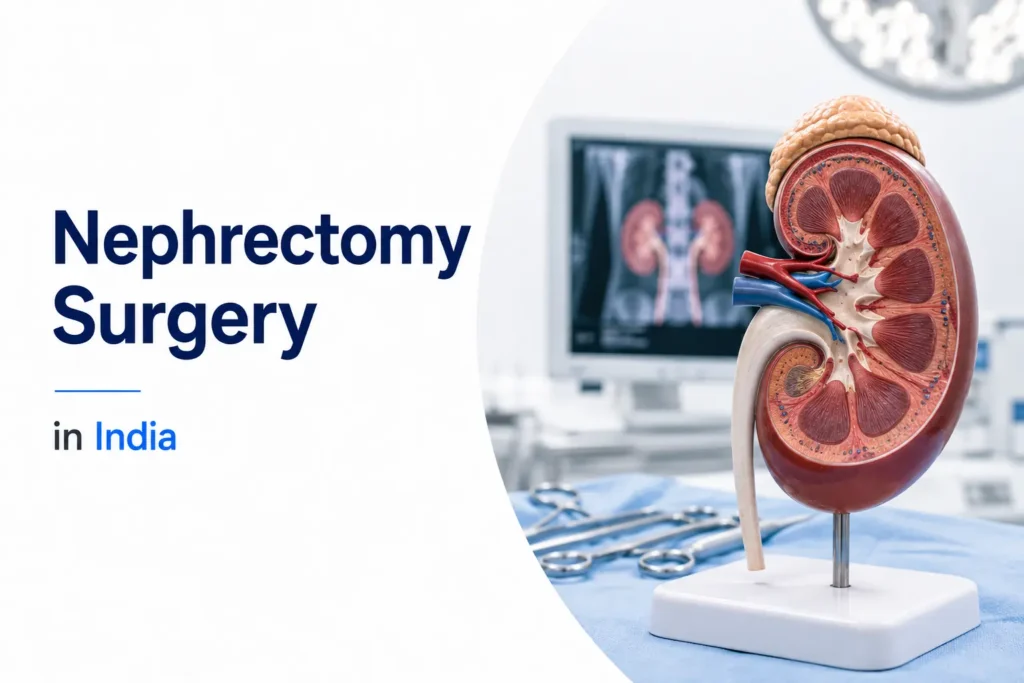
Kidneys are silent organs. Serious issues can develop unnoticed for months, with symptoms like a dull lower backache or constant exhaustion often dismissed as common problems. Often, a diagnosis, significant damage, or a tumor requiring removal is only found incidentally during scans for other reasons.
This sounds alarming at first. But today, Nephrectomy Surgery in India has completely shifted. It has moved away from large, painful open surgeries to advanced, minimally invasive techniques. It is a major procedure, but it is carefully planned to protect your overall health and get you back on your feet as quickly as possible.
Get Free Consultation Now
What Is Nephrectomy Surgery?
It is simply the clinical term for removing a kidney, either a piece of it or the entire organ. Kidneys are the body’s heavy duty filters, balancing fluids and flushing out waste.
But if one of them is diseased, cancerous, or actively threatening your health, removing it is often the safest path forward. The remarkable part about human biology is that if you remove one kidney, the remaining healthy kidney typically adapts to handle the workload largely on its own.
When Is Nephrectomy Surgery Needed in India
Doctors don’t remove a kidney unless it’s genuinely necessary. They typically suggest this operation when medication and other treatments haven’t worked, or when keeping the kidney poses too much risk to your health.
This might include aggressive kidney cancer, or a long-term disease that has significantly damaged the organ. In some cases, repeated infections or very large kidney stones cause enough lasting damage that the kidney tissue can’t be saved.
A urologist will review your medical scans closely before recommending nephrectomy in India.
Types of Nephrectomy Surgery in India
There is no one-size-fits-all approach here. How the surgery is performed depends on the extent of the problem.
- Partial nephrectomy: removing just the diseased portion of the kidney, leaving the healthy tissue intact.
- Radical nephrectomy: removing the entire kidney, usually along with surrounding fat and tissue.
- Laparoscopic nephrectomy: a minimally invasive approach using a small camera and specialized tools through a few small incisions.
- Open nephrectomy: the traditional approach, requiring a larger incision, usually reserved for larger tumors or more complex anatomy.
Conditions Treated with Nephrectomy
Doctors typically rely on this surgery for a few specific, serious situations.
- Kidney cancer: the most common reason, removing the tumor before it can spread.
- Severely damaged kidney: when chronic high blood pressure or disease leaves the organ non-functioning.
- Recurrent infections: when repeated infections scar the tissue beyond repair.
- Large kidney stones: significant stones that physically damage the internal kidney structures.
Tests Before Nephrectomy Surgery in India
The medical team needs a clear picture of your condition before surgery.
- Blood tests: to check how well the remaining kidney is filtering waste.
- Urine tests: looking for hidden proteins or active infections that need to be addressed first.
- CT scan or MRI: giving the surgeon a detailed view of the kidney, any tumor, and surrounding blood vessels.
- Heart and lung evaluation: since this is major surgery, confirming the heart can handle anesthesia.
These tests give the surgical team what they need to plan safely.
Risks and Complications of Nephrectomy
Removing a major organ carries real medical risks.
- Infection: any surgical incision carries some infection risk.
- Bleeding: kidneys process a large volume of blood, so bleeding during or after the procedure is something doctors monitor closely.
- Injury to nearby organs: rare, but possible given how closely packed abdominal organs are.
- Reduced kidney function: the most significant long-term concern, if the remaining kidney isn’t as healthy as expected, filtration issues can follow.
Nephrectomy Surgery Cost in India
For international patients, nephrectomy surgery in India typically costs between $1,800 and $5,800, averaging around $2,650 for standard cases. Laparoscopic radical nephrectomy specifically, one of the more commonly performed approaches, typically starts around $5,000 at major hospitals.
Partial nephrectomy generally costs somewhat less than radical nephrectomy, since it involves removing less tissue, though the exact figure depends on the case. Open surgery is typically less expensive than minimally invasive techniques, though it involves a longer recovery. The final cost depends on the type of surgery, the hospital, and case complexity. Medicsaz can put together a personalized cost estimate once a partner urologist has reviewed your case and scans.
How Medicsaz Supports Your Nephrectomy Surgery Journey in India
Medicsaz connects you with vetted partner hospitals and urologists experienced in nephrectomy surgery, and coordinates everything around the procedure, cost estimates, medical records review, hospital and doctor matching, travel and visa support, accommodation, and a point of contact throughout your stay in India.
If you’re ready to explore nephrectomy surgery in India, reach out for a free medical opinion and cost estimate. Most inquiries get a response within 30 minutes.
Life with One Kidney After Surgery
Here’s the genuinely reassuring part: life doesn’t have to radically change just because you’re missing a kidney. The remaining organ typically grows slightly larger over time and takes over much of the workload for both sides.
Post-nephrectomy, a strict diet isn’t usually required, but doctors emphasize good hydration, blood pressure monitoring, and avoiding excessive NSAIDs (like ibuprofen) due to kidney strain. An annual blood test is generally recommended for monitoring. With basic care, many patients experience minimal long-term impact on daily life.
Conclusion
Finding out you need an organ removed is a significant shock. But leaving a diseased, cancerous, or non-functioning kidney in place carries real ongoing risk.
Today, Nephrectomy Surgery in India is genuinely advanced. With skilled surgeons, robotic-assisted tools where appropriate, and closely monitored recovery protocols, this procedure is safer than it’s ever been. Once the initial healing phase is behind you, many patients are able to return to a largely normal, active life, though as with any major surgery, individual recovery and outcomes vary.
Frequently Asked Questions
What's the difference between partial and radical nephrectomy?
Partial nephrectomy removes only the diseased portion of the kidney, preserving healthy tissue, while radical nephrectomy removes the entire kidney along with surrounding fat and tissue.
Can I live a normal life with only one kidney?
Yes, the remaining kidney typically grows slightly larger and takes over much of the workload of both, allowing most people to live an active life afterward.
Is laparoscopic nephrectomy safer than open surgery?
Laparoscopic nephrectomy is minimally invasive with smaller incisions, generally leading to less pain, less blood loss, and faster recovery compared to traditional open surgery, though the right choice depends on individual case complexity.
What are the risks of nephrectomy surgery?
Risks include infection, bleeding, rare injury to nearby organs, and the possibility that the remaining kidney may not fully compensate for the one that was removed.
Will my remaining kidney be monitored after surgery?
Yes, an annual blood test is typically recommended to track how well the remaining kidney is functioning over time.
Is kidney removal surgery a permanent solution for kidney cancer?
For localized kidney cancer, nephrectomy can be highly effective, though ongoing monitoring is important to check for any recurrence.
Can both kidneys be affected by the same condition requiring removal?
It’s uncommon for both kidneys to require removal simultaneously; most conditions leading to nephrectomy affect one kidney, allowing the other to take over function.
Medically Reviewed
This page on Nephrectomy Surgery in India has been medically reviewed by Dr. Rashid Ali, MBBS, a Delhi Medical Council–registered practitioner (Registration No. DMC/R/36289), to ensure it reflects accurate, current, and evidence-based medical information.
At Medicsaz, every treatment page is checked by a licensed doctor before publication, not written by a marketing team alone. Dr. Rashid Ali review covers the accuracy of procedures, terminology, and claims described on this page, so patients researching Nephrectomy Surgery in India can rely on what they read here to make informed decisions.
Last medically reviewed: 09/09/2026
You can independently verify Dr. Rashid Ali’s registration on the Delhi Medical Council’s official website using Registration No. DMC/R/36289, or read more about his role as Medicsaz’s medical reviewer on his reviewer profile page.