
Intracytoplasmic Sperm Injection Treatment in India
Starting a family should be an exciting and natural progression. However, for many couples, it becomes a stressful, grueling marathon. When conception doesn’t happen as expected, people often feel overwhelmed by a multitude of tests and confusing treatment choices.
If male fertility issues are a factor, your physician has likely mentioned ICSI. Intracytoplasmic Sperm Injection Treatment in India has become very common in specialized fertility clinics over the past few years. While the name sounds highly technical, the fundamental concept is quite easy to understand once explained.
Get Free Consultation Now
What Is ICSI Treatment?
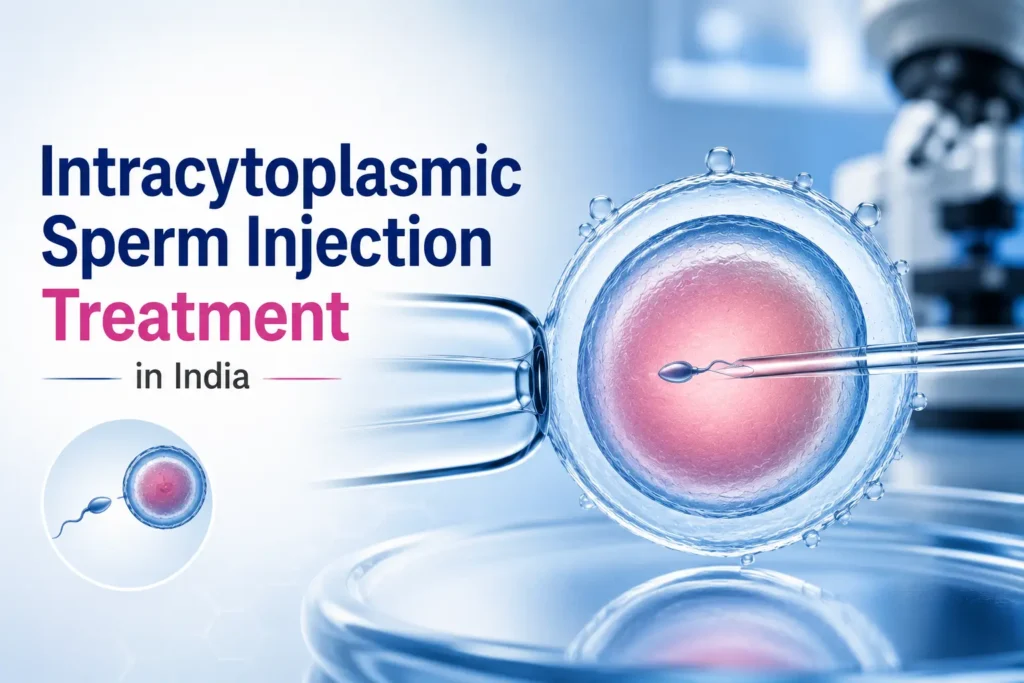
ICSI stands for Intracytoplasmic Sperm Injection. It is a highly specific type of assisted reproduction. In a natural conception scenario, millions of sperm are basically fighting to reach and penetrate the egg. It is a massive numbers game, but in ICSI, the lab completely bypasses that struggle. A single, structurally healthy sperm is carefully selected and literally injected right inside the egg using a microscopic needle.
Who Needs Intracytoplasmic Sperm Injection Treatment in India
People don’t automatically need ICSI just because they are struggling to conceive. Doctors specifically recommend it when the main issue is on the male side of the equation. You are usually looking at this treatment if you have:
- Low sperm count – Not enough numbers for natural fertilization to work.
- Poor sperm movement – The sperm literally cannot swim well enough to reach the target.
- Previous IVF failure – When standard IVF just didn’t result in any fertilized embryos earlier.
- Blocked sperm transport – When the sperm cannot leave the body naturally and have to be surgically retrieved.
How ICSI Is Different from IVF
People mix these up constantly. The main difference happens in the lab. In standard IVF, they put the eggs and thousands of sperm together in a dish and basically just wait for nature to take its course.
With ICSI, there is no waiting around or hoping for the best. The fertilization is manually forced by injecting a single sperm directly into the egg. Everything that happens after that—growing the embryo and transferring it to the uterus—is exactly the same as regular IVF.
Causes of Male Infertility Treated with ICSI
ICSI is the go-to fix when the sperm itself is struggling to get the job done. We are talking about issues like oligospermia (a terribly low count) or poor motility (they just can’t move right). Sometimes it is an issue with the actual shape of the sperm, making it physically impossible for them to penetrate the egg shell. And in cases of azoospermia, where there are literally zero sperm in the semen, ICSI allows doctors to extract them directly from the source and still make a pregnancy possible.
ICSI Procedure Step by Step
The whole process takes a few weeks of heavy dedication. First, the woman goes on specific medications to kick her ovaries into overdrive so they produce multiple eggs at once. Once those are ready, they are retrieved through a minor surgical procedure, and then on that exact same day, a sperm sample is collected from the male partner.
The lab selects the best sperm to inject into the eggs. The resulting fertilized eggs develop into embryos over several days. The strongest embryo(s) are then transferred to the uterus. Any remaining healthy embryos are usually frozen for future use.
Tests Before ICSI Treatment in India
Doctors don’t just guess your dosage. They always run a battery of tests first to see exactly what they are working with.
- Hormone tests – Checking the raw reproductive levels in both partners.
- Semen analysis – The absolute most critical test to map out count, speed, and shape.
- Ultrasound scan – Looking closely at the physical state of the ovaries and uterus.
- Infection screening – Making sure there is nothing quietly brewing that could ruin the transfer.
Success Rate of ICSI Treatment in India
How likely is this to actually work? That heavily depends on a few strict realities. Age is honestly the biggest hurdle. Younger women generally see much higher success rates simply because the raw egg quality is better.
But overall health, the specific cause of the infertility, and the quality of the resulting embryos dictate everything. For couples dealing exclusively with male infertility, ICSI comes up as an outstanding option. It is an absolute game-changer for improving fertilization chances.
Recovery and Care After an ICSI Procedure
While egg retrieval is classified as a minor surgical procedure, it can still have a physical strain. Patients likely have some mild cramps and uncomfortable bloating for a few days after the procedure.
After the embryo is transferred, doctors highly push you to take it easy. No heavy physical activity, no intense stress. Eating right and actually resting are huge here. You will have regular follow-ups to monitor exactly how things are progressing.
Intracytoplasmic Sperm Injection Treatment in India Cost
Intracytoplasmic Sperm Injection Treatment in India typically costs around $1,500 to $5,000 or more per cycle. ICSI is generally performed as part of an IVF treatment cycle, and the overall cost can vary depending on the fertility clinic, medications, laboratory services, and additional procedures required.
The exact cost depends on ovarian stimulation medicines, fertility investigations, egg retrieval, ICSI laboratory procedures, embryo culture and transfer, sperm retrieval if required, embryo freezing and storage, genetic testing, and the number of treatment cycles. Additional procedures such as PGT, TESA/PESA, donor sperm or eggs, or other fertility treatments may further increase the overall cost. These figures are general estimates, not fixed quotes. Eligibility and treatment are subject to applicable Indian ART regulations and the patient’s individual circumstances. Medicsaz can provide a personalized estimate after a partner fertility specialist reviews the patient’s medical records and treatment requirements.
How Medicsaz Supports Your Intracytoplasmic Sperm Injection Treatment in India Journey
Medicsaz connects international patients with vetted partner hospitals and experienced fertility specialists and reproductive medicine teams for Intracytoplasmic Sperm Injection Treatment in India. The team assists with medical record review, fertility clinic and specialist matching, treatment and cost estimates, travel and visa support, accommodation, and coordination throughout the patient’s treatment journey.
For patients exploring Intracytoplasmic Sperm Injection Treatment in India, Medicsaz can help identify an appropriate fertility specialist and treatment plan based on the patient’s medical records, fertility history, and clinical requirements, while providing guidance on expected costs and the overall treatment process.
Conclusion
Dealing with infertility is exhausting, but ICSI has completely rewritten the rulebook for male fertility issues. Intracytoplasmic Sperm Injection Treatment in India offers things that weren’t possible a generation ago. Now they have highly advanced, precise care. Put in the work, lean on your support system, and trust the science; it gives you a very real, tangible way to finally start your family.
Frequently Asked Questions
What's the actual difference between ICSI and regular IVF?
In regular IVF, eggs and sperm are placed together in a dish and fertilization happens naturally. In ICSI, a single sperm is manually injected directly into the egg — everything after that, including embryo growth and transfer, is the same.
Who actually needs ICSI instead of standard IVF?
ICSI is typically recommended when male infertility is the main factor — low sperm count, poor sperm movement, abnormal sperm shape, or previous IVF cycles that failed to fertilize.
Can ICSI help if there's zero sperm in the semen?
Yes — in cases of azoospermia, doctors can surgically extract sperm directly from the testicles and still use ICSI to achieve fertilization.
What determines ICSI's success rate?
The female partner’s age is the biggest factor, since egg quality declines with age. Overall health, the cause of infertility, and embryo quality also play a major role.
Does ICSI increase the risk of birth defects?
This is a common concern; couples should discuss individual risk factors with their fertility specialist, since outcomes depend on the underlying cause of infertility, not the ICSI procedure alone.
How long does the full ICSI process take?
From starting ovarian stimulation medication to embryo transfer, the process typically spans a few weeks, with egg retrieval and sperm collection happening on the same day.
Can ICSI be used after a failed IVF cycle?
Yes — previous IVF failure where eggs didn’t fertilize is one of the standard reasons doctors recommend switching to ICSI for the next attempt.
Medically Reviewed
This page on Intracytoplasmic Sperm Injection Treatment in India has been medically reviewed by Dr. Rashid Ali, MBBS, a Delhi Medical Council–registered practitioner (Registration No. DMC/R/36289), to ensure it reflects accurate, current, and evidence-based medical information.
At Medicsaz, every treatment page is checked by a licensed doctor before publication, not written by a marketing team alone. Dr. Rashid Ali review covers the accuracy of procedures, terminology, and claims described on this page, so patients researching Intracytoplasmic Sperm Injection Treatment in India can rely on what they read here to make informed decisions.
Last medically reviewed: 09/09/2026
You can independently verify Dr. Rashid Ali’s registration on the Delhi Medical Council’s official website using Registration No. DMC/R/36289, or read more about his role as Medicsaz’s medical reviewer on his reviewer profile page.