
Fontan Procedure in India
The identification of congenital heart disease in children is indeed a great shock to the Indian families affected. As the structure of the heart changes, its ability to maintain constant levels of oxygen in the body becomes difficult, leading to tiredness and poor growth in children.
In such conditions, surgical procedures in stages have to be done, where the last stage includes the Fontan procedure. Today, the Fontan procedure in India is carried out in specialized hospitals that aim at rectifying the circulation of the heart and the growth of the children.
Get Free Consultation Now
What Is the Fontan Procedure?
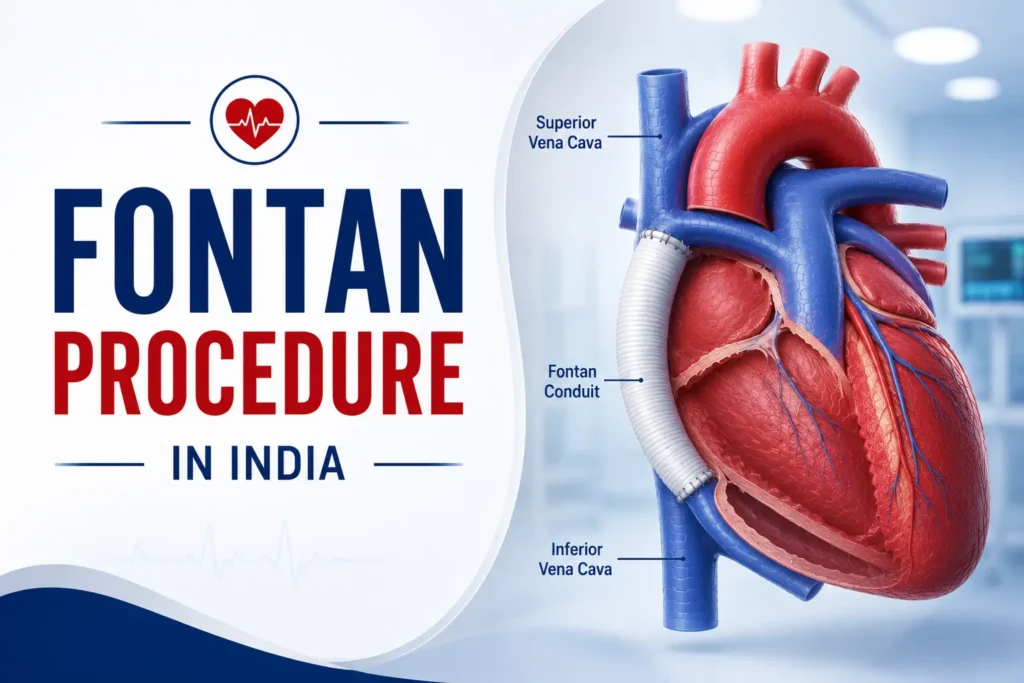
The Fontan operation is a palliative surgery that treats children suffering from a heart that has only a single ventricle. The heart normally has two ventricles which function in tandem, but here, there is just one functioning ventricle. This procedure involves the re-channeling of blood flow such that the deoxygenated blood from the body can be pumped to the lungs without having to move through the chambers of the heart. Therefore, this gives the single ventricle the chance to pump the oxygenated blood to the body.
This particular heart surgery only deals with the problem and not the cause, as the single ventricle condition persists throughout the life of the child and long-term monitoring is essential.
When Is the Fontan Procedure Needed
This surgery is recommended for children with complex congenital heart defects where a two-ventricle repair isn’t possible. Doctors consider this the final stage once earlier surgeries, like the Glenn procedure, have prepared the circulation for it. The timing depends on the child’s growth and whether their heart and lungs are ready for this stage.
Conditions Treated with Fontan Procedure
This procedure is used for structural heart defects, including:
- Single ventricle malformation – only one functional ventricular chamber.
- Tricuspid atresia – a missing or non-functioning tricuspid valve.
- Hypoplastic left heart syndrome (HLHS) – underdevelopment of the left side of the heart.
- Pulmonary atresia – a blocked blood supply to the lungs.
Symptoms That May Lead to Fontan Surgery
Children with these conditions often show the following signs before surgery:
- Bluish skin or lips: A sign of low oxygen levels in the blood.
- Fatigue: Tiring easily during feeding or normal activity.
- Growth delay: The body prioritizing basic survival over growth.
- Shortness of breath: Difficulty getting enough oxygen during activity.
Tests and Diagnosis Before Fontan Procedure in India
Clinical experts use detailed imaging to fully assess the heart’s condition before surgery:
- Echocardiography (Echo): To assess heart structure and pumping function.
- Cardiac catheterization: To measure pressure and blood flow inside the heart.
- MRI or CT scan: For a detailed look at the heart and surrounding blood vessels.
- Blood tests: To check overall health before surgery.
Fontan Procedure Explained
The surgery is performed under general anesthesia. A new pathway is created to connect the body’s main vein (inferior vena cava) directly to the pulmonary arteries. This allows blood to flow to the lungs without passing through the heart’s affected chambers. The surgical team monitors the child closely throughout to ensure blood flow is smooth and efficient.
Types of Fontan Techniques
There are two commonly used surgical approaches:
- Lateral tunnel Fontan: Uses a channel created inside the heart itself.
- Extracardiac Fontan: Uses an external tube (conduit) to reroute blood flow.
The choice depends on the child’s specific anatomy and stage of heart development.
Recovery After Fontan Procedure in India
Recovery takes place in a specialized pediatric cardiac unit, where the child is closely monitored. It typically takes several weeks for the child to heal properly after returning home.
Risks and Complications of the Fontan Procedure
As with any major heart surgery, there are risks that are closely monitored:
- Fluid buildup: Fluid accumulation around the lungs during recovery.
- Clot risk: Blood clots can form in the new circulation pathway.
- Rhythm issues: Temporary changes in heart rhythm after surgery.
- Reduced stamina: The body gradually adapts to the new circulation pattern.
Long-Term Care and Follow-Up
Despite the Fontan operation being able to provide better blood flow, it cannot heal the problem within the heart, which means that continuous follow-up by a specialist is required. With time, patients undergoing the Fontan operation may experience complications associated with the functioning of their liver, gastrointestinal tract, and/or heart rhythm, such as Fontan-related liver disease and protein-losing enteropathy; hence, continuous checking of these systems becomes an integral part of their treatment. Some patients may require certain medications to enhance heart function and prevent developing these complications. In rare cases, many years after surgery, it is necessary to perform heart transplantation.
Fontan Procedure in India Cost
Fontan Procedure in India typically costs around $5,000 to $13,500. The cost varies depending on the child’s congenital heart condition, complexity of the Fontan procedure, surgeon and hospital, preoperative investigations, cardiac catheterization, pediatric cardiac ICU stay, hospitalization, medications, and any additional procedures required.
The exact cost depends on the child’s medical condition and treatment requirements. These figures are general estimates, not fixed quotes. Complex cases requiring additional procedures, prolonged ICU care, or treatment of complications may cost more.
How Medicsaz Supports Your Fontan Procedure in India Journey
Medicsaz connects international patients with vetted partner hospitals and experienced pediatric cardiac surgeons for Fontan Procedure in India. The team assists with medical record review, hospital and surgeon matching, treatment and cost estimates, travel and visa support, accommodation, and coordination throughout the patient’s treatment journey in India.
For patients exploring Fontan Procedure in India, Medicsaz can help identify an appropriate pediatric cardiac specialist and treatment approach based on the child’s medical records, while providing guidance on expected costs and the overall treatment process.
Conclusion
The failure to treat the child’s heart symptoms in time is very risky and will greatly affect his/her health condition. Fontan Procedure in India provides an effective technique for dealing with complex single ventricle heart disease and ensuring proper development of the patient. However, it does not provide a cure, and regular follow-up by experts is vital in order to prevent any complications in the future. When properly managed, most patients live normal lives.
Frequently Asked Questions
Is the Fontan procedure a cure for congenital heart defects?
No. It’s a palliative procedure that reroutes circulation to work around a single functioning ventricle — it doesn’t correct the underlying heart defect. Most children who undergo it need lifelong specialist follow-up.
What long-term complications can happen after a Fontan procedure?
Over decades, many patients develop complications such as liver disease, protein-losing enteropathy (a digestive condition causing protein loss), arrhythmias, or reduced exercise tolerance. Regular monitoring helps catch these early.
Will my child need more surgery after the Fontan procedure?
Most children don’t need another major heart surgery right after Fontan, but some may require procedures later in life to manage complications, and in more advanced cases, heart transplantation may eventually be considered.
What is the life expectancy after a Fontan procedure?
Long-term studies show survival of roughly 74% at 10 years, 61% at 20 years, and 43% at 30 years after surgery, though outcomes continue to improve with modern surgical techniques and better long-term monitoring.
Can a child live a normal, active life after the Fontan procedure?
Many children do lead active lives, attend school, and participate in most activities, though some may have reduced exercise tolerance compared to peers. Your cardiologist can guide activity levels based on your child’s specific heart function.
How many surgeries lead up to the Fontan procedure?
The Fontan is typically the final stage in a series of surgeries for single-ventricle heart defects — usually preceded by an initial surgery in infancy and the Glenn procedure in early childhood.
Medically Reviewed
This page on Fontan Procedure in India has been medically reviewed by Dr. Rashid Ali, MBBS, a Delhi Medical Council–registered practitioner (Registration No. DMC/R/36289), to ensure it reflects accurate, current, and evidence-based medical information.
At Medicsaz, every treatment page is checked by a licensed doctor before publication, not written by a marketing team alone. Dr. Rashid Ali review covers the accuracy of procedures, terminology, and claims described on this page, so patients researching Fontan Procedure in India can rely on what they read here to make informed decisions.
Last medically reviewed: 09/09/2026
You can independently verify Dr. Rashid Ali’s registration on the Delhi Medical Council’s official website using Registration No. DMC/R/36289, or read more about his role as Medicsaz’s medical reviewer on his reviewer profile page.