
Epidural Stimulation Treatment in India
Very serious injuries to the spinal cord have the potential to transform one’s whole way of living. Many patients find themselves dealing with an abrupt incapacity to physically move around, unable to stand up, walk, or even sit down without having any problems. The reason behind that problem lies in the fact that the channels of communication between the brain and the limbs are seriously damaged. In cases where traditional physiotherapy does not yield results anymore, some people turn to other emerging treatment methods.
One such method that is being explored and provided nowadays is epidural spinal cord stimulation. The principle of this treatment is based on applying electrical impulses to the nerve circuits beneath the injured area. One needs to clearly realize from the very beginning that this is a relatively new treatment method which still undergoing clinical research trials all around the world and is not a guaranteed treatment at all.
Patients considering Epidural Stimulation Treatment in India should have a clear, honest conversation with their specialists about what current evidence actually supports for their specific situation.
Get Free Consultation Now
What Is Epidural Stimulation Therapy?
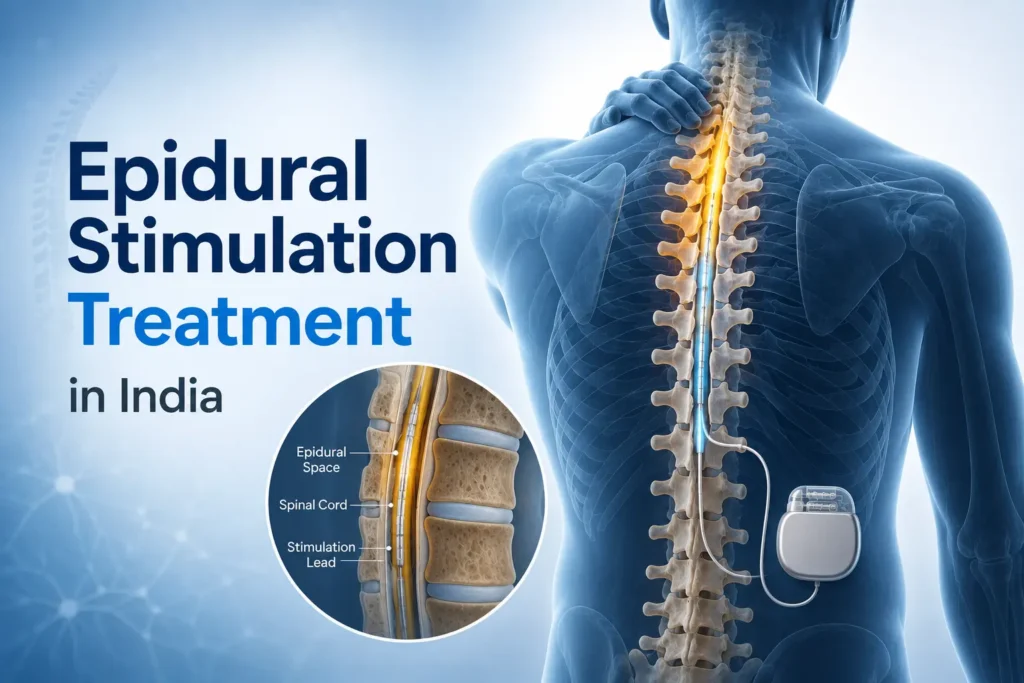
Essentially, this treatment entails the introduction of regulated electric pulses into the nerves at levels of the nervous system below the site of the spinal cord injury through an implantable device placed above the spinal cord protective covering. It is believed that stimulation with such a device helps to reactivate the spinal networks below the injury as well as allow brain signals to pass through in certain instances.
It should be noted that the devices utilized for such stimulation have been approved as treatment for chronic pain and not for spinal cord injuries. Thus, the treatment for SCI-induced paralysis falls under investigational treatment, and many of the facts regarding its efficacy have come from research investigations only.
Conditions Where Epidural Stimulation Is Being Studied
Researchers have investigated this approach for spinal cord injuries, including both complete and incomplete injuries, chronic paralysis, and related motor and autonomic function issues (such as bladder control). Results have varied significantly based on the specific type and completeness of the injury, and research is ongoing to better understand who benefits most and why.
How Epidural Stimulation May Help Nerve Function
When injury occurs, the communication of the normal instructions of the brain is significantly impaired even before they get to the muscles. The implantable device sends constant, low electrical impulses to the neural pathways below the injury. In scientific experiments, the continuous stimulation has assisted some patients to experience voluntary muscle contraction, posture balance, and bladder control, especially in combination with physical training for several months to even years. The outcomes have not been consistent with all patients, as well as patients with complete injuries who stand due to stimulation but have no voluntary control at all.
Who Might Be a Candidate for Epidural Stimulation
This isn’t an assured solution for all individuals with paralysis, and at the moment, there’s no proof that this treatment is effective for all people with paralysis. The severity and extent of the injury, the functioning of nerves after injury, cardiovascular status, and bone mass are taken into consideration before deciding whether this therapy is appropriate. But most importantly, this therapy needs great effort and dedication for intensive physical exercises in the long term. This is a major challenge without which no significant improvement will be possible.
Considering the fact that this therapy is experimental, it’s important to ask specific questions about it prior to choosing this treatment. Questions include: Is this treatment performed according to the research protocol, or is it used in a clinical setting? What are the results achieved by this clinic for a particular injury?
Tests and Evaluation Before Epidural Stimulation Treatment in India
Before any procedure, a multidisciplinary team will conduct an assessment that will include high-resolution MRI scans of the spine to assess the injury, manual muscle tests, electromyography, and general physical fitness. This helps to identify whether there have been any benefits of this treatment modality on the patient’s injury profile.
Epidural Stimulation Procedure Explained
The implantation itself takes place under general anesthesia. A surgeon positions electrode leads in the epidural space over the target nerve circuits, then connects them via a wire to a small, programmable pulse generator placed under the skin, usually in the abdomen or upper gluteal area. After implantation, the device is programmed and adjusted based on the patient’s individual responses, a process that typically continues over an extended period.
Potential Benefits Reported in Research
In research settings, some participants combining stimulation with intensive daily training have experienced improvements such as increased blood circulation, improved core stability, voluntary stepping movements, independent sitting, and reduced chronic nerve pain. These outcomes are genuinely meaningful for the individuals who experience them, but they are not guaranteed, and results vary significantly from person to person.
Risks and Complications of Epidural Stimulation
As with any implanted device, there are risks involved, including localized infection near the pulse generator, minor bleeding, and temporary discomfort as the body adjusts. There is also a small risk of electrode displacement if a patient moves too vigorously during early healing, which may require reprogramming or a minor repositioning procedure.
Long-Term Care and Follow-Up Monitoring
Meaningful outcomes with this technology require years of ongoing, intensive rehabilitation and monitoring, not a one-time procedure. Regular follow-up visits are necessary to track progress, monitor the device’s battery and function, and adjust stimulation settings as needed. This is a long-term, demanding partnership between patient and care team, not a quick fix.
Epidural Stimulation Treatment in India Cost
Epidural Stimulation Treatment in India typically costs around $18,000 to $35,000. The cost varies depending on the patient’s spinal cord injury, stimulation system, implant and electrode selection, surgeon, hospital, anesthesia, diagnostic evaluation, hospitalization, rehabilitation, and postoperative programming.
The exact cost depends on the patient’s neurological condition and treatment plan, including preoperative assessments, trial stimulation when required, implantation, hospital and surgical charges, rehabilitation, and follow-up care. Complex cases or advanced implant systems may increase the overall cost. These figures are general estimates, not fixed quotes, and the final cost should be confirmed after evaluation by a neurosurgeon and rehabilitation team.
How Medicsaz Supports Your Epidural Stimulation Treatment in India Journey
Medicsaz connects international patients with vetted partner hospitals and experienced neurosurgeons and rehabilitation specialists for Epidural Stimulation Treatment in India. The team assists with medical record review, specialist and hospital matching, treatment and cost estimates, travel and visa support, accommodation, and coordination throughout the patient’s treatment journey.
For patients exploring Epidural Stimulation Treatment in India, Medicsaz can help identify an appropriate specialist and suitable treatment approach based on the patient’s neurological condition and medical records, while providing guidance on expected costs and the overall treatment process.
Conclusion
Epidural stimulation represents a genuinely promising area of ongoing research for people living with paralysis, but it remains an investigational treatment, not an established, guaranteed clinical solution. Before pursuing Epidural Stimulation Treatment in India, patients and families deserve a clear, honest conversation about the current evidence, what specific outcomes have actually been documented, and the significant long-term commitment required for any chance of meaningful benefit.
Frequently Asked Questions
Is epidural stimulation an approved, standard treatment for spinal cord injury?
No — it remains largely investigational. The devices used were originally approved for chronic pain treatment, and their use for spinal cord injury is still being studied through research programs rather than offered as standard, guaranteed care.
Will epidural stimulation definitely help me walk again?
Not necessarily — outcomes vary significantly between individuals and injury types. Some research participants have regained voluntary movement or standing ability, while others have not, and results depend heavily on the specific injury and extensive, ongoing training.
Does the device alone restore movement, or is more required?
More is required — meaningful results in research studies have come from combining stimulation with years of intensive, consistent physical training, not from the implant alone.
What questions should I ask before considering this treatment?
Ask whether it’s being offered as part of a structured research protocol or standard care, what specific outcomes the center has documented, and what the required long-term training commitment actually looks like.
Does epidural stimulation work the same way for complete and incomplete spinal cord injuries?
No — outcomes differ significantly. Some people with complete injuries have achieved standing through stimulation without regaining true voluntary control, while people with incomplete injuries have sometimes shown different types of improvement.
What are the risks of epidural stimulation implantation?
Risks include infection near the device, minor bleeding, temporary discomfort during adjustment, and a small chance of the electrode shifting, which may require reprogramming or a minor follow-up procedure.
Medically Reviewed
This page on Epidural Stimulation Treatment in India has been medically reviewed by Dr. Rashid Ali, MBBS, a Delhi Medical Council–registered practitioner (Registration No. DMC/R/36289), to ensure it reflects accurate, current, and evidence-based medical information.
At Medicsaz, every treatment page is checked by a licensed doctor before publication, not written by a marketing team alone. Dr. Rashid Ali review covers the accuracy of procedures, terminology, and claims described on this page, so patients researching Epidural Stimulation Treatment in India can rely on what they read here to make informed decisions.
Last medically reviewed: 09/09/2026
You can independently verify Dr. Rashid Ali’s registration on the Delhi Medical Council’s official website using Registration No. DMC/R/36289, or read more about his role as Medicsaz’s medical reviewer on his reviewer profile page.