Deep Brain Stimulation in India
For neurological disorders like Parkinson’s, motor control impairment severely limits independence. When medication fails, Deep Brain Stimulation in India offers an advanced neuromodulation therapy to regulate the brain’s electrical activity.
This intervention achieves neurological stabilization through the surgical placement of electrodes in targeted brain regions, which are designed to modulate abnormal nerve signaling involved in movement control. Currently, these sophisticated medical strategies ensure the preservation of patient well-being by achieving comprehensive stabilization of motor function and facilitating advanced recovery.
Get Free Consultation Now
What Is Deep Brain Stimulation (DBS)?
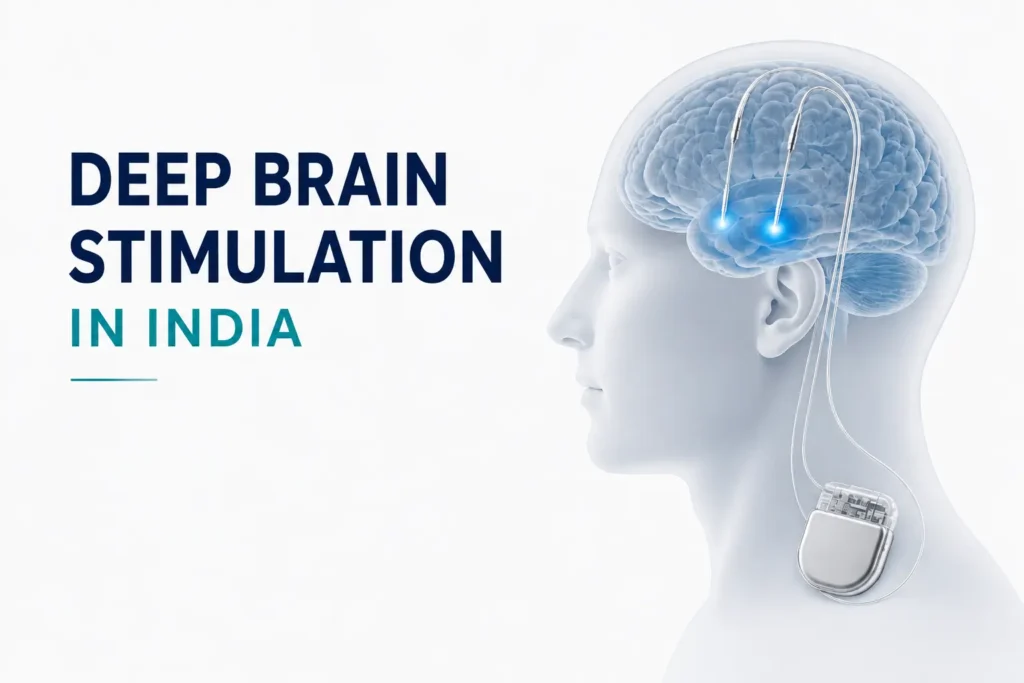
Deep Brain Stimulation (DBS) is a long-term neuromodulation therapy that uses implanted electrodes and a pulse generator to deliver adjustable electrical signals to specific brain targets. Small wires (electrodes) are put inside the brain to modulate abnormal signals. A small pulse generator (similar in concept to a pacemaker) is implanted under the skin, usually near the collarbone, and connected to the brain electrodes. This device acts as the main control for the system. This setup helps manage severe movement problems that have become very difficult to control.
Important: DBS helps manage symptoms and can reduce medication requirements. It does not cure the underlying condition or stop disease progression. The system requires battery replacement (non-rechargeable batteries every 3–5 years; rechargeable batteries every 10–15+ years) and ongoing programming adjustments.
Who Needs Deep Brain Stimulation in India
DBS is considered for carefully selected patients whose symptoms are no longer well controlled with medication or who experience disabling side effects from high-dose pharmacological treatments, and who are deemed suitable after thorough multidisciplinary evaluation. Common clinical indications for this intervention include:
- Parkinson’s Disease – Managing tremors and rigidity when medication control becomes difficult or side effects are limiting.
- Essential Tremor – Controlling involuntary shaking that disrupts activities like eating or writing.
- Dystonia – Reducing abnormal muscle contractions and posturing in selected cases.
- Failed Medication Response – When symptoms no longer respond adequately to medication adjustments.
Symptoms That May Lead to DBS
Movement problems often start quietly, maybe with a slight slowness or a small tremor in the hands. But they get much worse, causing painful stiffness or uncontrolled involuntary movements (dyskinesia), often related to long-term medication use, that make every move difficult. Noticing these first signs early is the best way to prevent a total loss of coordination and help people get their independence back.
Typical signs of these issues are shaking that gets worse when you’re stressed, dragging a foot when you walk, or a face that seems “frozen” because the muscles aren’t working right. These symptoms mean the part of the brain that controls movement is failing. When symptoms become difficult to control with medication, a specialist may evaluate whether DBS is appropriate.
Conditions Treated with DBS in India
In India, specialists employ Deep Brain Stimulation as a neuromodulation therapy for chronic movement disorders stemming from nervous system damage. This procedure helps manage symptoms and can reduce medication requirements, rather than offering a cure for the underlying disease. Prior to the procedure, doctors conduct a thorough multidisciplinary evaluation (including a movement disorder neurologist, neurosurgeon, neuropsychologist, and psychiatrist) to confirm the patient’s suitability for DBS.
Tests Before Deep Brain Stimulation in India
A successful outcome relies on accurate imaging and clinical evaluation before surgery. Doctors in India utilize high-tech tools like 3T MRI and specialized CT scans to create a detailed look at the brain’s anatomy. This pre-operative phase involves identifying the exact coordinates for electrode placement within specific brain targets (such as the subthalamic nucleus, globus pallidus internus, or ventral intermediate nucleus of the thalamus).
- Brain Imaging – Creating a 3D map of the brain anatomy to plan the surgical approach.
- Neurological Exam – Testing motor strength and coordination to baseline the patient’s status.
- Levodopa Challenge – Measuring how symptoms respond to medication to help predict the potential benefit of DBS.
- Cognitive and Psychiatric Testing – Ensuring the patient’s cognitive and mental health status is suitable for the procedure and that expectations are realistic.
Recovery After DBS Surgery
Recovery is an achievable but gradual process that takes some amount of emotional strength and patience on the part of the patient. People usually stay in the hospital for a number of days during which the healing process of the incisions starts and their vital signs are checked. The programming usually starts a few weeks following surgery when the postoperative swelling subsides, and it continues to be changed in order to maximize symptom control and reduce the incidence of side effects.
- Programming sessions – This is where the doctors gradually make adjustments to the device over several weeks to months to achieve a balance between symptom control and side effect minimization.
- Incision care – Observation of the incisions made in the scalp and chest to see if there is healing.
- Medication adjustment – Adjustments to medications may be done as the program settings are optimized.
Risks and Complications of DBS
While generally safe when performed by experienced teams, DBS carries risks that should be discussed thoroughly before the procedure:
- Intracranial Bleeding (Hemorrhage) – Occurs in approximately 1–2% of cases; can cause stroke-like symptoms.
- Infection – May occur at the incision sites or around the hardware (approximately 3–5%); may require antibiotics or hardware removal.
- Lead Migration or Fracture – The electrodes can shift or break, requiring repositioning or replacement.
- Hardware Malfunction – The pulse generator or connections may fail and need replacement.
- Stimulation-Related Side Effects – Tingling, muscle tightness, speech or balance changes, visual effects, or mood/cognitive effects that may require programming adjustments.
- Seizures – Rare but possible during or after electrode placement.
- Battery Depletion – Requires scheduled replacement surgery every few years depending on battery type and settings.
Not all side effects resolve on their own; some require programming adjustments, medication changes, or surgical revision. Your team will monitor closely and make adjustments as needed.
Life After Deep Brain Stimulation in India
Post-DBS, patients experience significant improvement as involuntary movements cease. Agonizing tremors stop, making daily activities like dressing and walking easier and more balanced. The shift from constant shaking to stability is liberating for both the patient and family.
Long-term follow-up ensures optimal device function through regular programming sessions and monitoring for any hardware or symptom changes. Patients are encouraged to maintain an active, healthy routine for final physical stabilization. With proper care and ongoing management, DBS provides longer-term symptom control when carefully managed with follow-up programming and device maintenance.
- Realistic Expectations: DBS improves motor symptoms that respond to levodopa (in Parkinson’s), but does not help with balance, speech, or cognitive issues—and may sometimes worsen them.
- The underlying disease continues to progress; DBS manages symptoms but does not stop the condition.
- Regular follow-up, programming adjustments, and battery replacements are necessary for long-term benefit.
Cost of Deep Brain Stimulation in India
Deep Brain Stimulation in India typically ranges from around $15,000 to $28,000. The cost can vary depending on the type of DBS system, the hospital, the neurosurgical team, the complexity of the procedure, and the patient’s individual treatment requirements.
The exact cost also depends on preoperative brain imaging and assessments, the DBS device and battery type, surgeon and anesthesia fees, hospital stay, programming sessions, medications, and follow-up care. These figures are general estimates, not fixed quotes. Medicsaz can help arrange a personalized cost estimate after a partner specialist reviews the patient’s medical records and treatment requirements.
How Medicsaz Supports Your Deep Brain Stimulation in India Journey
Medicsaz connects international patients with vetted partner hospitals and specialists experienced in neurosurgery and DBS procedures, and coordinates everything around the process: cost estimates, medical records review, hospital and doctor matching, travel and visa support, accommodation, and a point of contact throughout your stay in India.
If you’re ready to explore Deep Brain Stimulation (DBS) in India, reach out for a free consultation and cost estimate. Most inquiries get a response within 30 minutes.
Conclusion
Not getting help for symptoms like shaking (tremors) or stiffness is dangerous and can make your health much worse. India has modern brain centers that offer a safe and effective neuromodulation therapy called Deep Brain Stimulation to help manage symptoms more effectively over the long term.
Deep Brain Stimulation in India is one of the most effective ways to get back good control over your movements and body balance for a long time, when carefully selected and managed by a multidisciplinary team.Modern care makes recovery as smooth as possible, helping you return to a more stable, working, and independent life.
Frequently Asked Questions
How long does the DBS battery last, and what happens when it needs replacement?
Non-rechargeable batteries typically last 3–5 years, while rechargeable batteries can last 10–15 years or more, depending on your stimulation settings. When the battery runs low, you’ll need a minor outpatient surgery to replace the pulse generator in your chest. The brain electrodes usually stay in place. Rechargeable systems require regular charging (usually daily or every few days) using an external device placed over the skin.
Will I still need to take Parkinson's medications after DBS surgery?
Yes, most patients continue taking medications after DBS, though doses are often reduced. DBS works best in combination with medication, not as a replacement. Your neurologist will adjust your medications gradually during the programming phase to find the right balance between stimulation settings and drug therapy. Stopping medications entirely is rare and not recommended for most patients.
Can the DBS settings be adjusted if my symptoms change over time?
Yes, one of the major advantages of DBS is that it’s adjustable and reversible. As your condition progresses or your symptoms change, your neurologist can reprogram the device during office visits. This fine-tuning process may happen frequently in the first few months after surgery and then periodically as needed. The device can also be turned off temporarily if side effects occur.
What are the most common side effects from the electrical stimulation itself?
Stimulation-related side effects depend on which brain area is being stimulated and the settings used. Common ones include tingling or pulling sensations, muscle tightness, slurred speech, balance problems, double vision, or mood changes. Many of these can be reduced or eliminated by adjusting the stimulation parameters. Your programming team will work with you to find settings that maximize benefit while minimizing unwanted effects.
Is DBS safe to undergo if I need an MRI or other medical procedures in the future?
Most modern DBS systems are MRI-conditional, meaning MRI scans can be done safely under specific conditions (certain MRI strength, head-only scans, with the device programmed appropriately). Always inform any doctor or imaging technician that you have a DBS implant before any procedure. Some medical procedures like diathermy, electrocautery, or certain types of radiation therapy may require special precautions or device adjustments.
Why isn't DBS recommended for everyone with Parkinson's disease or tremor?
DBS works best for patients whose symptoms still respond well to levodopa (for Parkinson’s) but who have motor fluctuations, dyskinesia, or medication side effects. It’s not suitable for people with significant cognitive decline, untreated psychiatric conditions (severe depression, psychosis), poor general health, or those with Parkinson’s symptoms that don’t respond to levodopa (like severe balance or speech problems). A thorough multidisciplinary evaluation is done to ensure DBS is likely to help and that risks are acceptable for each individual patient.
Medically Reviewed
This page on Deep Brain Stimulation in India has been medically reviewed by Dr. Rashid Ali, MBBS, a Delhi Medical Council–registered practitioner (Registration No. DMC/R/36289), to ensure it reflects accurate, current, and evidence-based medical information.
At Medicsaz, every treatment page is checked by a licensed doctor before publication, not written by a marketing team alone. Dr. Rashid Ali review covers the accuracy of procedures, terminology, and claims described on this page, so patients researching Deep Brain Stimulation in India can rely on what they read here to make informed decisions.
Last medically reviewed: 09/09/2026
You can independently verify Dr. Rashid Ali’s registration on the Delhi Medical Council’s official website using Registration No. DMC/R/36289, or read more about his role as Medicsaz’s medical reviewer on his reviewer profile page.