
Cochlear Implants in India
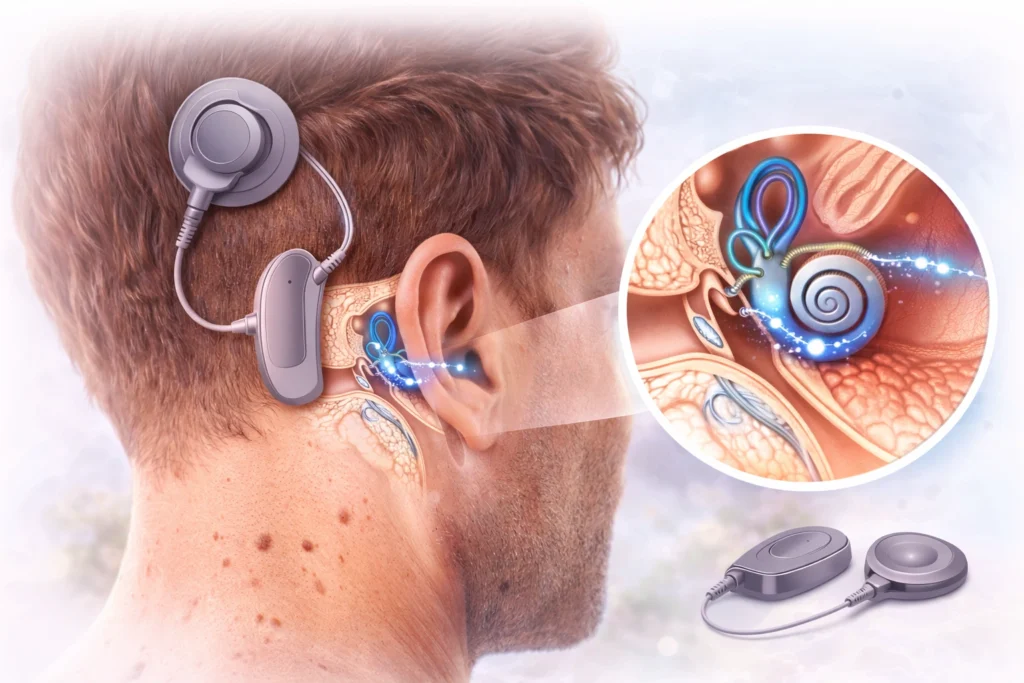
For someone struggling with profound hearing loss, the world often feels like it’s on a permanent mute setting. While hearing aids work for some, they frequently fail when the ear’s internal hardware has hit a functional breaking point.
Cochlear Implants in India offer a definitive clinical reset, acting as a high-tech bypass for this biological theft of sound. Unlike a standard aid, an implant is a mechanical device that directly stimulates the hearing nerve to restore the vital flow of information.
Get Free Consultation Now
What Is a Cochlear Implant?
A cochlear implant is a sophisticated electronic bridge designed to bypass the damaged scaffolding of the inner ear. It consists of an internal electrode array placed inside the cochlea and an external processor that sits behind the ear.
This setup serves as a secondary scaffolding for the auditory system, converting noise into electrical signals. These pulses allow the brain to understand speech and music, preventing a total system failure of the patient’s communication.
Who Needs Cochlear Implants?
Surgery is rarely the first step for minor hearing issues; instead, specialists reserve this mechanical fix for those with a total system failure of their hearing. In India, several groups are the primary focus for this structural relocation of care:
- Children Born with Hearing Loss: Early intervention before age three is a mandatory requirement for natural speech.
- Adults with Progressive Loss: Those who have seen a slow-motion biological crash of their hearing over time.
Non-responders to - Hearing Aids: People who can hear sound but cannot understand clarity or speech logistics.
Signs That May Require a Cochlear Implant
If the world is becoming a series of muffled vibrations, your auditory system might be reaching a breaking point. Common red flags include children not responding to their names or failing to develop words by age two.
Adults often experience total social withdrawal because the mental effort to understand is physically exhausting. Needing the TV at 100% volume while still struggling to grasp words is another indicator that the internal plumbing needs a reset:
- Speech Delay: Children failing to respond to their names or develop basic vocabulary.
- Social Withdrawal: Adults avoid conversations due to the physical exhaustion of trying to hear.
- Volume Failure: Needing devices at maximum volume while still missing the context of words.
Causes of Severe Hearing Loss
The breakdown of the ear’s internal architecture can happen because of genetic factors or chronic infections like meningitis. In India, long-term exposure to loud noise often triggers a biological crash where the hair cells lose their structural integrity.
Sometimes the failure is simply a result of the natural aging process, where the system stops responding to standard amplification. Identifying the cause through a thorough clinical evaluation is the first step toward a permanent mechanical fix.
Tests and Diagnoses for Cochlear Implants in India
Clinical experts in India use high-tech mapping to ensure the patient is a perfect candidate for the mechanical reset. This diagnostic phase ensures the care is targeted and the recovery is predictable for every patient:
- Audiological Testing: Advanced “speech-in-noise” tests to see how much the current plumbing can handle.
- Imaging (MRI/CT): High-tech mapping to ensure the cochlea is physically open and the auditory nerve is intact.
- Psychological Evaluation: Ensuring the family has the “emotional grit” needed for the long-term rehab process.
Cochlear Implant Procedure Explained
The surgery is a meticulous clinical session performed under general anesthesia to install the new internal scaffolding. The surgeon makes a small opening in the bone and threads the electrode array into the cochlea to bypass the dead tissue.
By 2026, many Indian clinics will use robotic assistance to ensure the highest survival rate of the delicate inner ear structures. The external part is usually “switched on” a few weeks later, once the initial healing of the site is complete.
Rehabilitation and Speech Therapy
The “switch-on” is just the start of the race to reclaim sound. Since the brain is receiving a new kind of electrical signal, it needs a structural relocation of how it processes speech and noise:
- Speech Therapy: A mandatory requirement where therapists help the brain map electrical pulses to real words.
- Mapping Sessions: Audiologists fine-tune the device settings regularly to find the best balance for the user.
- Family Training: The family must learn the logistics of daily listening exercises to ensure the best outcome.
Risks and Complications of Cochlear Implants
While the success rate is incredibly high, any hospitals intervention carries a small risk of localized irritation. These minor issues are managed carefully to prevent a total system failure or secondary infection at the surgical site.
Modern Indian clinical centers minimize these risks through sterile environments and advanced surgical techniques. Most complications are rare and fix themselves as the internal balance of the ear settles into its new state:
- Infection Risk: Minimized through sterile clinical environments and specialized post-op care.
- Localized Irritation: Temporary discomfort at the surgical site as the internal tissues heal.
- Mechanical Adjustments: Minor fine-tuning required to ensure the external processor stays secure.
Life After Cochlear Implant in India
Life after an implant is a total transformation that restores physical independence. In 2026, new “Smart Sync” technology allows users to swap out lost processors and have their settings automatically copied in seconds.
This ensures a stable and connected life, allowing children to attend regular schools with confidence. Adults return to their professional careers, ending the biological theft of their social and professional potential.
Conclusion
Relying on a failing system when a permanent fix is available is a risky move that leads to a health collapse. Cochlear Implants in India offer a permanent diagnostic reset, removing the uncertainty from the biological theft of stamina.
A structured cochlear implant plan is the most reliable way to secure long-term communication and core stability. Modern care makes sure the recovery is smooth, and the future is entirely active and clear.
Medically Reviewed
This page on Cochlear Implants in India has been medically reviewed by Dr. Rashid Ali, MBBS, a Delhi Medical Council–registered practitioner (Registration No. DMC/R/36289), to ensure it reflects accurate, current, and evidence-based medical information.
At Medicsaz, every treatment page is checked by a licensed doctor before publication, not written by a marketing team alone. Dr. Rashid Ali review covers the accuracy of procedures, terminology, and claims described on this page, so patients researching Cochlear Implants in India can rely on what they read here to make informed decisions.
Last medically reviewed: 09/09/2026
You can independently verify Dr. Rashid Ali’s registration on the Delhi Medical Council’s official website using Registration No. DMC/R/36289, or read more about his role as Medicsaz’s medical reviewer on his reviewer profile page.