
Bilateral Hand Transplant in India
We use our hands for almost everything, for eating, writing, working, or holding someone’s hand. But when a person loses both hands because of an accident, infection, or severe injury, life changes completely. Dependence on others increases, and simple daily tasks become difficult, resulting in emotional stress also becoming very high.
In the beginning, doctors usually try prosthetic hands and rehabilitation. Prosthetic support works well for many patients. But for a very small group of patients, prosthetics are not enough. In such rare and complex situations, doctors may suggest hand transplantation. Bilateral hand transplant in India is still uncommon, but it is possible in a few specialised centres. They perform surgery with experienced transplant and reconstruction teams.
Get Free Consultation Now
What Is Bilateral Hand Transplant Surgery?
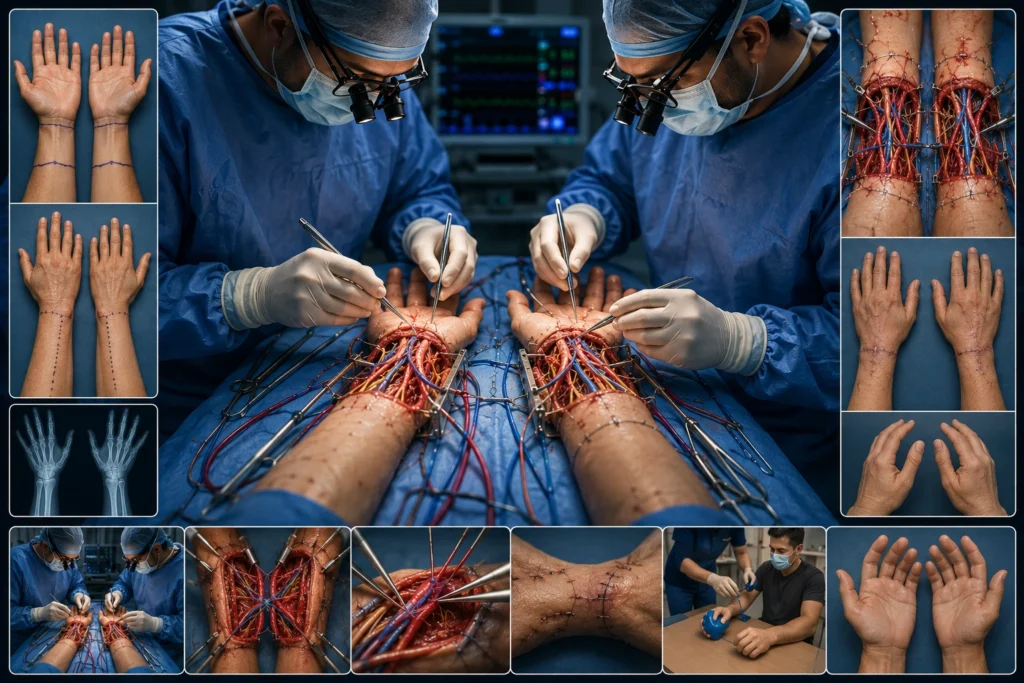
This surgery is a permanent fix where hands and forearms from a deceased donor are attached to the patient. It is an incredibly detailed process. Surgeons connect the radius and ulna bones, repair the tendons, and join the radial and ulnar arteries. The goal is a structural relocation so that blood flow reaches the new tissues. The median, radial, and ulnar nerves must slowly regrow into the new hands so the brain can eventually communicate with the fingers.
Who Needs a Bilateral Hand Transplant?
Doctors do not suggest this surgery for every hand amputation patient. A bilateral hand transplant is mainly considered for people who have lost both hands. The patient needs to be physically fit to undergo long and complex surgery. It is usually offered when the patient struggles to use prosthetic hands. It can also be done when prosthetics do not provide enough function for daily life.
Doctors also look at the patient’s mental strength and long-term commitment because recovery and rehabilitation can take years.
Conditions Treated with Bilateral Hand Transplant
A bilateral hand transplant surgery is mainly done in very specific and severe situations. Conditions commonly seen include:
- Severe amputation trauma – Accidents on roadways, workplace accidents, or blasts resulting in amputation of both hands.
- Infection or burns – Extremely rare instances when infections or burns result in the loss of both hands.
- Vascular or tissue damage – Situations in which the flow of blood is compromised, damaging hand tissue irreparably.
The transplant procedure is only recommended after all other alternatives have been carefully considered.
Donor Matching and Waiting List for Bilateral Hand Transplant in India
Hand transplantation depends on deceased donors. Doctors look for a donor whose hands match the patient’s in size, skin tone, and tissue structure as closely as possible. Blood group compatibility and immune matching are also very important.
After surgery approval, the name is placed on a waiting list because suitable donors are rare and the matching process is very strict. This can make the waiting period long. During this time, doctors continue counselling and physical preparation. This waiting phase is one of the most difficult parts of the bilateral hand transplant.
Tests Required Before Bilateral Hand Transplant Surgery
Before approving the surgery, doctors carry out a detailed medical and psychological evaluation. This usually includes:
- Blood group and immune matching tests
- Heart and lung fitness tests
- Infection screening
- Scans of the arm bones and muscles
- Psychological assessment
Doctors must be sure that the patient can tolerate a long surgery. Also, patients need to take lifelong medicines and long-term rehabilitation.
Bilateral Hand Transplant Surgery Process Step by Step
Doctors complete all medical tests and final donor matching. The operation takes many hours. Two surgical teams usually work at the same time.
- One team prepares the donor’s hands, while the other prepares the patient’s arms.
- Surgeons then connect bones, tendons, blood vessels, and nerves one by one with extreme precision.
After surgery, the patient is shifted to the transplant ICU for continuous monitoring.
Medicines and Rejection Prevention After Bilateral Hand Transplant
The immune system may reject the transplanted hands, but that can be prevented with the help of medicines that suppress the immune system for the rest of the patient’s life. Patients have been advised to take their medications on time, visit their doctors from time to time, and practice proper hygiene. They should not get themselves infected; otherwise, it might lead to an infection. Patients must stick to a proper medication regimen as it is vital in order to ensure long-term success after a bilateral hand transplantation in India.
Physiotherapy and Hand Rehabilitation After Transplant
Rehabilitation is the most important part of recovery. Physiotherapy and occupational therapy start early and can last for years. Patients slowly learn to move fingers and perform daily activities again. As nerves heal, sensation and fine movements return very gradually. Daily training, patience, and strong motivation help a lot in functional recovery.
Life After Bilateral Hand Transplant
After a successful hand transplant, life can be very meaningful for many patients. Many people regain useful hand movement and basic sensation. Simple tasks such as eating, dressing, and writing become possible again.
However, life after transplant also requires discipline. Lifelong medicines, regular hospital visits, and continued hand exercises remain part of the daily routine. Emotional support from family is equally important. For selected patients, a bilateral hand transplant in India offers physical improvement and also emotional and social confidence.
Conclusion
A bilateral hand transplant is a rare but life-changing clinical move. It is a complex path that requires the best surgical teams. Bilateral Hand Transplant in India offers the advanced care and long-term follow-up needed to make this a reality. With the right diagnosis and a structured recovery, patients can finally fix the source of their disability.
Medically Reviewed
This page on Bilateral Hand Transplant in India has been medically reviewed by Dr. Rashid Ali, MBBS, a Delhi Medical Council–registered practitioner (Registration No. DMC/R/36289), to ensure it reflects accurate, current, and evidence-based medical information.
At Medicsaz, every treatment page is checked by a licensed doctor before publication, not written by a marketing team alone. Dr. Rashid Ali review covers the accuracy of procedures, terminology, and claims described on this page, so patients researching Bilateral Hand Transplant in India can rely on what they read here to make informed decisions.
Last medically reviewed: 09/09/2026
You can independently verify Dr. Rashid Ali’s registration on the Delhi Medical Council’s official website using Registration No. DMC/R/36289, or read more about his role as Medicsaz’s medical reviewer on his reviewer profile page.