
ACL Reconstruction Surgery in India
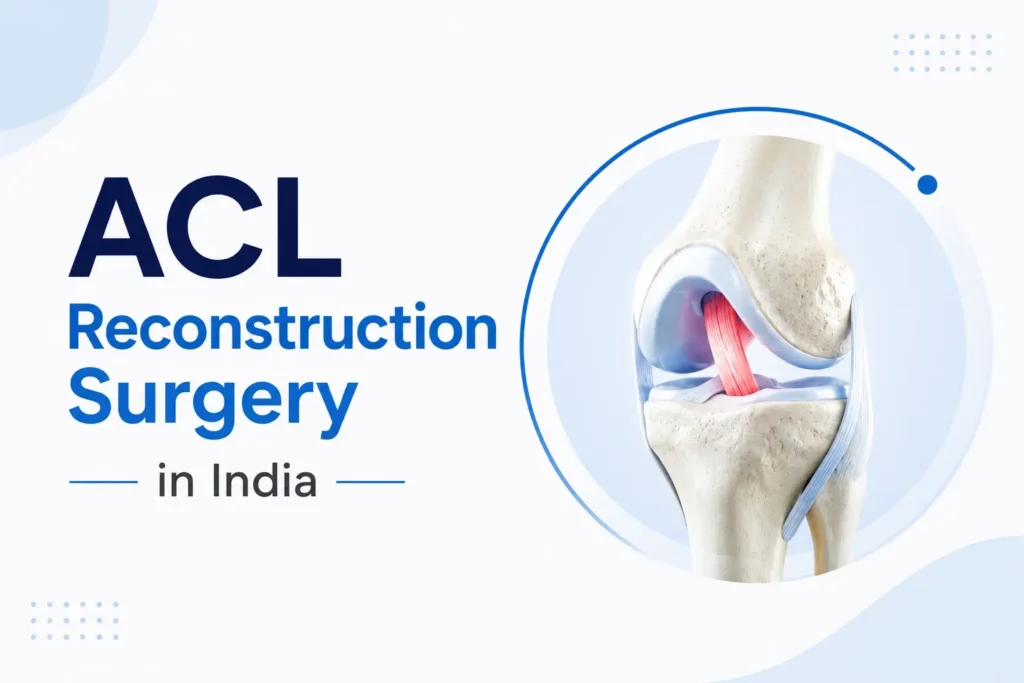
Suddenly jerky actions like twisting while participating in physical activities can cause knee injuries that have a distinct popping sound, sudden sharp pain, and swelling. This may make the knee hinge unstable enough to feel as though it could give out when stressed.
The anterior cruciate ligament is crucial for the knee joint’s stability. If there are severe injuries to its structure, a mechanical reset will be needed to allow the knee to take weight again. The current treatment for ACL reconstruction surgery in India involves arthroscopic surgeries and extensive physical therapy sessions.
Get Free Consultation Now
Overview of ACL Reconstruction Surgery
Instead of attempting to sew together any frayed ligaments, the surgical intervention substitutes a torn stabilizing ligament from within the structure of the knee joint with healthy tissue. This technique seeks to reconstruct the basic architecture and strengthen the joint’s support system to allow for participation in intense physical activity again. Arthroscopic techniques utilize high-tech cameras and tiny entryways into the knee joint.
Identifying ACL Tears: Warning Signs and Causes
Ligament rupture commonly results from overloads caused by mechanical factors that surpass the strength of ligaments, including collisions during games, poor landings following jumps, or shearing due to twisting with the foot fixed.
Early signs of a complete ligament rupture are critical in ensuring that the entire ligament does not fail:
- Structural Pop: The occurrence of a definite crack when the injury takes place.
- Fluid Build-up: Rapid swelling caused by fluid build-up within the structural components.
What Is ACL Reconstruction Surgery?
ACL reconstruction is a corrective procedure used to replace a torn stabilizer ligament inside the knee framework. Instead of stitching the frayed tissue back together, specialists perform a foundation overhaul using a healthy tissue graft. The goal is to clear out the broken mechanics, secure the joint infrastructure, and allow a return to heavy physical impact. The procedure uses arthroscopy, meaning small access points and high-tech cameras do the heavy lifting instead of large open incisions.
Common Causes of ACL Injury
Ligament failures occur when the joint faces a sudden mechanical overload that exceeds its structural limits:
- Rotational Shear: Sudden twisting of the joint while the foot remains locked to the ground.
- Impact Crashes: Direct collisions during football, basketball, or cricket matches.
- Awkward Landings: Structural collapse after falling from a jump.
Symptoms of ACL Tear You Should Not Ignore
A complete structural tear causes immediate logistical failures within the knee architecture. Recognizing these red flags early prevents a total system collapse:
- Structural Pop: A distinct cracking or popping sound at the exact moment of the crash.
- Fluid Accumulation: Rapid swelling as the internal framework fills with fluid.
- Load-Bearing Failure: Severe pain when attempting to stand or walk.
- Joint Slippage: Continuous instability where the hinge framework slips out of alignment.
How ACL Injuries Are Diagnosed in India
Orthopedic specialists use specific mechanical stress tests and imaging mapping to confirm a total framework failure:
- Stability Assessment: Manual knee examinations to check for excessive shifting in the joint architecture.
- MRI Mapping: High-definition scans to visualize the exact depth of the ligament tear.
- X-Ray Screening: Used to rule out secondary bone fractures or structural chips.
Treatment Options for ACL Reconstruction Surgery in India
The roadmap for recovery depends entirely on the activity demands placed on the patient’s physical structure. Minor partial tears might recover using knee braces and targeted physical therapy to strengthen the surrounding muscle architecture. However, complete structural failures in active individuals or athletes require surgery to prevent long-term wear, tear, and secondary joint degradation.
ACL Reconstruction Surgery Procedure Explained
The mechanical overhaul takes place under general or spinal anesthesia using micro-instruments. The surgeon clears out the ruined ligament fibers to prepare the factory site. Next, they drill precise retention tunnels into the thigh and shin bone architecture. The replacement graft is pulled through these channels and locked down tightly using specialized screws, creating a brand-new stabilization framework for the joint.
Types of Grafts Used in ACL Surgery
The new ligament blueprint requires a strong tissue source to handle future mechanical strain:
- Autograft (Patellar Tendon): Patellar tendon autograft taken from the knee of the patient; very strong.
- Autograft (Hamstring): Very popular approach involving the thigh tendons; causes less discomfort in front of the knee.
- Allograft (Sterile Donor Tissue): Donor tissue is sterilized and used for difficult procedures or multiple ligament reconstruction.
Recovery and Rehabilitation After ACL Reconstruction Surgery in India
Rebuilding the system requires a structured maintenance timeline and patience. Intensive physiotherapy begins almost immediately to clear out stiffness and restart the muscle production line:
- Range Reset: Early movements to prevent the joint architecture from freezing up.
- Strength Loading: Targeted exercises to fire up the quadriceps and hamstrings.
- Balance Logistics: Re-training the nerve pathways to stabilize the leg during movement.
Risks and Complications of ACL Reconstruction
While such surgeries can be highly successful in resetting joints, there would still be certain risks involved for the patient. Possible complications may include joint stiffness, swelling in the affected joint, and nerve irritation around the incisions made during surgery. Other possible complications would include the failure of the graft or tearing due to early return to strenuous activities.
Returning to Sports After ACL Surgery
Resuming high-impact sports requires a complete clearance of all functional metrics:
- Physical Checks: Athletes undergo strict testing to ensure muscle balance and agility logistics have returned.
- Graft Maturation: Waiting several months because rushing back onto the field risks a total system re-tear.
- Mindset Build: Rebuilding psychological confidence to pre-injury levels before full contact play.
Conclusion
An ACL tear is a major structural failure of the knee mechanics, but executing a timely clinical reset completely shifts the long-term outcome. ACL Reconstruction Surgery in India merges state-of-the-art arthroscopic technology with a skilled orthopedic workforce to reconstruct an imperfect joint structure. By following a carefully laid out rehabilitation program, patients can restore their full mechanical stability and resume their lives without any fear.
Medically Reviewed
This page on ACL Reconstruction Surgery in India has been medically reviewed by Dr. Rashid Ali, MBBS, a Delhi Medical Council–registered practitioner (Registration No. DMC/R/36289), to ensure it reflects accurate, current, and evidence-based medical information.
At Medicsaz, every treatment page is checked by a licensed doctor before publication, not written by a marketing team alone. Dr. Rashid Ali review covers the accuracy of procedures, terminology, and claims described on this page, so patients researching ACL Reconstruction Surgery in India can rely on what they read here to make informed decisions.
Last medically reviewed: 09/09/2026
You can independently verify Dr. Rashid Ali’s registration on the Delhi Medical Council’s official website using Registration No. DMC/R/36289, or read more about his role as Medicsaz’s medical reviewer on his reviewer profile page.