
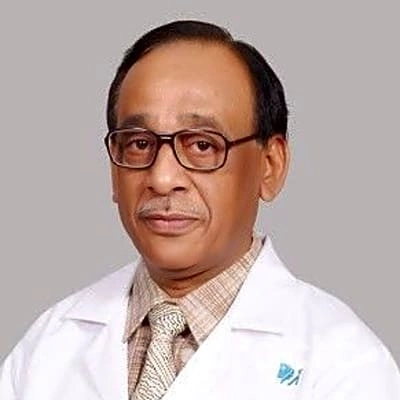
Dr. K K Saxena
Experience: Over 40 years
Indraprastha Apollo Hospitals
New Delhi, India
Introduction
Dr. K K Saxena is a Senior Consultant Interventional Cardiologist at Indraprastha Apollo Hospitals. He has been working at Apollo since 1996, nearly three decades at the same hospital, and has forty years of experience in cardiology.
About Dr. K K Saxena
Dr. K K Saxena got his DM in Cardiology from Mangalore University. Then went to Royal Adelaide Hospital in Australia for an interventional cardiology fellowship. That Australian training is where the catheter-based precision work was sharpened. His forty years in this field mean this practice started when angioplasty itself was still a relatively new concept in India.
Dr. K K knows which blockage genuinely needs a stent and which one will do fine with medicines alone comes from decades of seeing outcomes, not from reading about them. Before Apollo was at the National Heart Institute and Batra Hospital. Over thirty-five years of teaching postgraduate students alongside clinical practice and published research in the Indian Heart Journal.
Qualifications
- MBBS & MD (Medicine) — Jiwaji University, Gwalior.
- DM (Cardiology) — Mangalore University, Karnataka.
- Interventional Cardiology Fellowship — Royal Adelaide Hospital, Australia.
Awards & Recognition
- At Indraprastha Apollo since 1996.
- Previously at the National Heart Institute and Batra Hospital.
- Over 35 years of teaching postgraduate students.
- Publications in the Indian Heart Journal.
- Interventional fellowship from the Royal Adelaide Hospital, Australia.
Specialities & Expertise
- Complex coronary angioplasty and stenting
- Balloon mitral valvotomy
- Pulmonary valvuloplasty
- Device closure for congenital heart defects
- Permanent pacemaker implantation
- Coronary radial and femoral
Patient Experience & Approach
Patients report that angiography results are clearly explained by Dr. K K Saxena, detailing the blockage location and determining if a stent or medication is needed. The physician’s forty years of experience ensure that stent decisions are based on decades of outcomes, not just guidelines. Families of older patients needing valve procedures were grateful for the less invasive balloon valvotomy option over open-heart surgery. Pacemaker recipients appreciated the simple explanation of their rhythm problem, the device’s function, and post-implantation life.
Frequently Asked Questions
How do I book an appointment with Doctor?
You can book a consultation with the doctor through Medicsaz by contacting our team via WhatsApp or the “Book an Appointment” button on this page. We’ll coordinate the appointment directly with the hospital and assist with scheduling based on your treatment needs.
Is the doctor experienced in treating international patients?
Yes, the doctor has treated patients from various countries, with experience managing cross-border care, language coordination, and treatment planning for patients traveling to India.
Can I get a free medical opinion before travelling to India?
Yes. Medicsaz facilitates free preliminary medical opinions; you can share your medical reports with our team, and we’ll coordinate a review with the concerned specialist or hospital before you finalize your travel plans.
Does Medicsaz arrange travel, visa, and accommodation for treatment with Doctor?
Yes. Medicsaz provides end-to-end support, including medical visa assistance, travel coordination, accommodation, and local support throughout your treatment journey.
What languages does the doctor communicate in?
The doctors generally communicate in languages such as English and Hindi, and Medicsaz additionally provides translator support for patients who need assistance in other languages.
Content Verification
This doctor profile has been compiled and written by the Medicsaz editorial team based on publicly available hospital records, credentials, and professional experience. It has been medically reviewed by Dr. Rashid Ali, MBBS (Delhi Medical Council Reg. No. DMC/R/36289) for accuracy of medical qualifications, specializations, and terminology. Medicsaz does not employ this doctor directly; we facilitate access to verified specialists at partner hospitals in India. For the most current information on this doctor’s practice, please consult the hospital directly or contact our team.