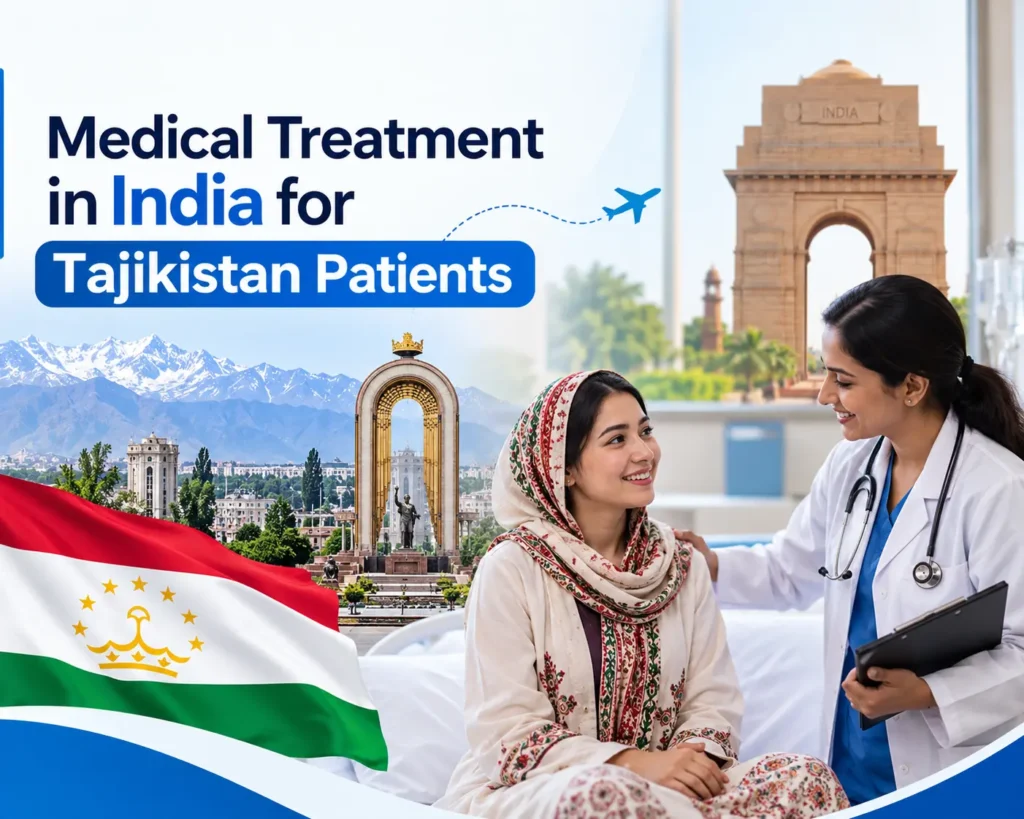
Medical Treatment in India for Tajikistan Patients: A Complete Guide
Medical treatment in India for Tajikistan patients is a big decision, and it helps to have clear facts before you book anything. At Medicsaz, we have supported more than 3,000 international patients, we work with major hospitals in Delhi NCR, and we provide Russian translators. This guide explains the visa and its fees, the non-stop flight from Dushanbe, the costs, how to choose a hospital and how to plan your recovery. It also answers the doubts families most often raise before they decide.
Get Free Consultation Now
Key Facts at a Glance
- e-Medical visa fee for Tajik citizens: US$80, plus a 3% bank charge on card payments
- e-Medical Attendant visa: US$80 for each family member, with up to two attendants per patient
- Validity: one year (365 days) from arrival, with multiple entries
- When to apply: at least four days before your arrival date, with an arrival date up to 120 days ahead
- Passport: valid for at least six months from arrival in India, with two blank pages
- Flight: non-stop Dushanbe–Delhi on Somon Air, about 2 hours 40 minutes, on Mondays and Thursdays, departing at 11:00
- Language: Russian translators provided by Medicsaz
Quick Answers
Can Tajik citizens travel to India for treatment?
Yes. Tajikistan is on India’s e-Visa eligible-country list, and the e-Medical and e-Medical Attendant visas are available online.
Is the visa free?
No. The government fee is US$80 per medical visa, so a patient and one attendant pay US$160 before bank charges.
Can I get an opinion before I travel?
Yes. We share your reports with our partner hospitals so specialists can review your case before you book anything.
Why Tajikistan Patients Consider Treatment in India
Patients usually look to India for a second opinion on a serious diagnosis, access to a specialist or technology that is hard to reach at home, or a hospital team that works with international patients every day. For patients in Tajikistan, the flight from Dushanbe is under three hours, which makes India one of the shortest journeys for specialist care. India is not the right answer for every patient. For many conditions, treatment at home is a sound choice, and the best starting point is always your diagnosis and a clear opinion on your reports.
Medical Visa for India: Fees and Steps for Tajik Citizens
Patients travelling for treatment need a medical visa. India’s current official e-Visa fee schedule lists the government fee for Tajikistan at US$80 for the e-Medical visa and US$80 for each e-Medical Attendant visa, plus a 3% bank charge on card payments. The e-Medical visa is valid for one year from arrival, with multiple entries, and the portal grants only two attendant visas per patient. Apply at least four days before you arrive. The portal lets you choose an arrival date up to 120 days ahead. Your passport must be valid for at least six months from arrival and have two blank pages. The hospital generates your invitation letter through the Government of India’s Medical and Ayush Visa portal, and your Medicsaz coordinator arranges this.
You can also apply in person at the Embassy of India in Dushanbe, 48 Khusravi Dekhlavi Street, after submitting the form online. The embassy lists up to five working days for processing. Use only the official portal or the embassy, because fake sites imitate them.
Travelling From Dushanbe to India
Somon Air flies non-stop from Dushanbe to Delhi in about 2 hours 40 minutes. Flights run on Mondays and Thursdays, departing Dushanbe at 11:00 and arriving in Delhi at 14:10, which means you land in the afternoon and can reach your hospital the same day. With two flights a week, plan your dates around them and book early. Delhi has some of the country’s largest hospitals, so the non-stop flight suits many patients.
Keep your original reports, scans and current medicines in your hand luggage, and carry printed copies of your visa and your hospital paperwork. Patients from Khujand and other cities should plan how they will reach Dushanbe before the international flight.
Health entry rules. Tajikistan is not a yellow-fever country, but India requires a valid yellow-fever certificate if you have been in, or passed through, a country where yellow fever occurs, including if you leave the airport transit area. The certificate becomes valid 10 days after vaccination, and you must carry the original.
Medical Treatment in India for Azerbaijani Patients: Step by Step
- Gather your records: Collect diagnosis reports, scans, laboratory results, previous prescriptions and discharge summaries, with scans in digital form where possible.
- Share them with us: Send your records to Medicsaz, and we check what is missing so nothing delays your review.
- Get an opinion: We share your case with suitable partner hospitals so specialists can review it and give you an opinion.
- Compare your options: You can compare opinions and written estimates before you commit to anything.
- Choose your hospital and doctor: Once you decide, we confirm dates and the paperwork the hospital needs.
- Apply for your visa: Use the official portal or the embassy and the documents they ask for, as explained above.
- Travel to India: We meet you at the airport and help you settle into your accommodation.
- Begin treatment: Treatment follows the plan agreed with your doctor, and tests may be repeated before the final plan is confirmed.
- Recover and be discharged: You stay for any recovery period the doctor advises and receive your reports and medication instructions.
- Plan your follow-up: We plan your follow-up care before you leave, not after.
Which Treatments Can You Ask About?
Depending on your diagnosis, patients ask about opinions in cancer care, heart surgery, joint replacement, spine and brain surgery, kidney and liver care, fertility treatment and other specialities. Our partner hospitals cover many specialities, but not every case is a good fit. Tell us your diagnosis, and we will tell you honestly whether we can help.
Two areas need extra planning. Organ transplantation is tightly regulated in India, so donor eligibility, relationship requirements and legal approvals are confirmed with the hospital before you travel. Fertility treatment is also regulated: foreign nationals can have IVF, but surrogacy is not available to foreigners.
Hospitals We Work With
Our main partner hospitals are in Delhi NCR. They include BLK-Max Super Speciality Hospital, Fortis Escorts Heart Institute, Indraprastha Apollo Hospital, Manipal Hospital in New Delhi and Max Super Speciality Hospital in Saket, along with other hospitals across the wider NCR. The names are listed alphabetically, not ranked. We match your diagnosis to the hospital and doctor who treat your condition regularly. See all our partner hospitals.
Treatment Costs in India: Planning Ranges
Cost is one of the first questions families ask, and there is no single answer. The ranges below come from published international-patient cost guides, checked on 17 October 2026. They are planning figures, not quotations.
| Treatment | Typical range in India (USD) |
|---|---|
| Heart bypass surgery (CABG), standard | $3,500 – $9,000 |
| Heart valve replacement | $5,000 – $9,000 |
| Knee replacement | $5,000 – $14,000 |
| Kidney transplant | $10,500 – $25,000 |
| IVF (one cycle) | $2,500 – $5,000 |
Robotic and complex procedures cost more.
Want an estimate for your own case? Send your reports to Medicsaz for a free medical opinion. We provide a free cost estimate to patients who are planning treatment in India.
Your final cost depends on your diagnosis, the hospital, the doctor, the implants or technique used, the room category, tests, medicines, the length of stay and any complications. Flights, accommodation and daily expenses are separate from the hospital bill. Always ask for the estimate in writing, with the currency stated.
Common Doubts, Answered Honestly
Families often tell us the same worries before they decide. Here are straight answers, including where the honest answer is “it depends”.
Is my case too serious to travel?
Only your doctors can judge that. Whether you are fit to fly, and how long you can safely be away, depends on your condition. Send your reports first. A specialist’s opinion can tell you whether travel makes sense before you spend money on tickets.
Do I really need to go to India at all?
Not always. For many conditions, treatment at home is a sound choice, and a specialist’s opinion on your reports sometimes answers your question without a journey. We would rather you hear that early.
Will I understand what the doctors say?
Doctors and hospital records in India generally use English. Medicsaz provides Russian translators for your consultations and hospital stay. If you need support in Tajik, tell us when you enquire, and we will confirm what is available. Never sign a consent form you do not fully understand.
What if the estimate changes?
It can. A written estimate is based on the information available before you arrive, and the final plan and cost can change after examination and tests. Ask what the estimate includes and excludes, and what happens if more treatment is needed.
What if I need more time than I planned?
Your e-Medical visa is valid for one year with multiple entries. Tell your hospital early if your treatment may take longer than expected.
Will my doctor at home accept the records?
Ask for a discharge summary, test reports, medication instructions and a written follow-up plan before you leave. We help you collect these from the hospital, so your own doctor can continue your care.
Will I be alone?
No. Our team meets you at the airport, helps you settle in and stays in touch through your treatment, and your attendants can travel with you.
Does my insurance cover this?
It depends on your policy. Ask your insurer in writing whether planned treatment abroad is covered, and keep every itemised bill.
How to Choose a Hospital and Doctor
Choose the hospital before you choose the city. Look for recognised quality standards such as NABH or JCI accreditation, then check the doctor’s experience with your specific condition. Ask whether the hospital has an international patient department and a dedicated coordinator, what the written estimate includes and excludes, and what happens if complications occur. A good hospital explains the plan, the risks and the alternatives openly, and welcomes your questions. If you prefer, Medicsaz can ask these questions on your behalf and share the answers with you in writing.
Documents to Prepare
A complete file makes the first specialist review more useful. Prepare your passport, a medical summary, diagnosis and blood-test reports, scans and imaging reports, previous prescriptions, discharge summaries, operation reports and a list of your current medicines. For cancer cases, add biopsy and pathology reports and any previous chemotherapy or radiation notes. For heart cases, add ECGs, echocardiograms and angiography reports. Indian hospitals usually need important records in English, so ask us about translation early.
Is Treatment at Home Enough?
For many conditions, treatment in Tajikistan is a sound choice, and your own doctor can help you judge that. India becomes worth considering when you want a second opinion, when your condition is rare or complex, or when you need a particular specialist or technology. International treatment is not appropriate if you are medically unstable or cannot safely travel. Every treatment carries risks, and results vary from patient to patient, so decide only after you understand the benefits, risks and alternatives, and talk to your own doctor first.
Russian Translator Support
Understanding your doctor matters as much as the treatment itself. Medicsaz provides Russian translators, so you can describe your symptoms clearly and follow every explanation, from consultations and test results to the treatment plan and consent discussions.
Accommodation and Staying Close to the Hospital
We meet you at the airport and help you choose accommodation near the hospital, which matters most if you need to return for repeated visits. Think about the distance to the hospital, lift access, space for your attendant and any dietary needs, and tell us in advance so we can inform the hospital.
Aftercare When You Return to Tajikistan
Recovery continues after you leave the hospital. Before you travel home, ask for a discharge summary, test reports, medication instructions and a written follow-up plan. We help you collect these from the hospital. Share them with your doctor in Dushanbe or your own city, and arrange online follow-up consultations with your Indian team. Learn which symptoms need urgent attention, and do not change any medicines without your doctor’s advice.
How Medicsaz Supports Tajikistan Patients
Medicsaz is a medical tourism facilitator, not a hospital, and our team stays with you throughout the journey. We review your records, share your case with our partner hospitals and coordinate the paperwork with them. When you arrive, we meet you at the airport, help you choose accommodation near the hospital and bring a Russian translator to your consultations. We help with cost estimates, ask the hospital your questions on your behalf and respond to new enquiries within 30 minutes, so you are not left waiting for answers. We stay in touch with the hospital during your treatment and help you remain connected with your Indian doctors after you return home. Medical decisions always stay with your doctors.
Conclusion
Medical treatment in India for Tajikistan patients works best when you take it one step at a time. Prepare your records, get opinions and written estimates before you travel, choose a hospital with real experience in your condition, and use the non-stop flight from Dushanbe. Plan your recovery and follow-up before you leave. If you are considering treatment in India, contact Medicsaz for a free medical opinion, and our team will help you take the next step.
Frequently Asked Questions
Do Tajik citizens need a visa for medical treatment in India?
Yes. Tajik citizens can apply for the e-Medical visa online, or apply in person at the Embassy of India in Dushanbe.
How much is the e-Medical visa for Tajik citizens?
The official fee schedule lists US$80 for the e-Medical visa and US$80 for the e-Medical Attendant visa, plus a 3% bank charge on card payments.
How long is the e-Medical visa valid?
One year from the date of arrival, with multiple entries.
How early should I apply?
At least four days before your arrival date. The portal lets you choose an arrival date up to 120 days ahead.
Are there direct flights from Dushanbe to India?
Yes. Somon Air flies non-stop from Dushanbe to Delhi in about 2 hours 40 minutes, on Mondays and Thursdays, departing at 11:00.
Does Medicsaz provide a translator?
Yes. Medicsaz provides Russian translators for your consultations and hospital stay.
Do I need a yellow-fever certificate?
Tajikistan is not a yellow-fever country, but India requires a valid certificate if you have been in, or passed through, a country where yellow fever occurs. The certificate becomes valid 10 days after vaccination, and you must carry the original.
Medically Reviewed
This page has been medically reviewed by Dr. Rashid Ali, MBBS, a Delhi Medical Council–registered practitioner (Registration No. DMC/R/36289), to ensure it reflects accurate, current, and evidence-based medical information.
At Medicsaz, every treatment page is checked by a licensed doctor before publication, not written by a marketing team alone. Dr. Rashid Ali review covers the accuracy of procedures, terminology, and claims described on this page, so patients researching can rely on what they read here to make informed decisions.
Last medically reviewed: 17/10/2026
You can independently verify Dr. Rashid Ali’s registration on the Delhi Medical Council’s official website using Registration No. DMC/R/36289, or read more about his role as Medicsaz’s medical reviewer on his reviewer profile page.