Brain Tumor Treatment in India for Patients from Uzbekistan
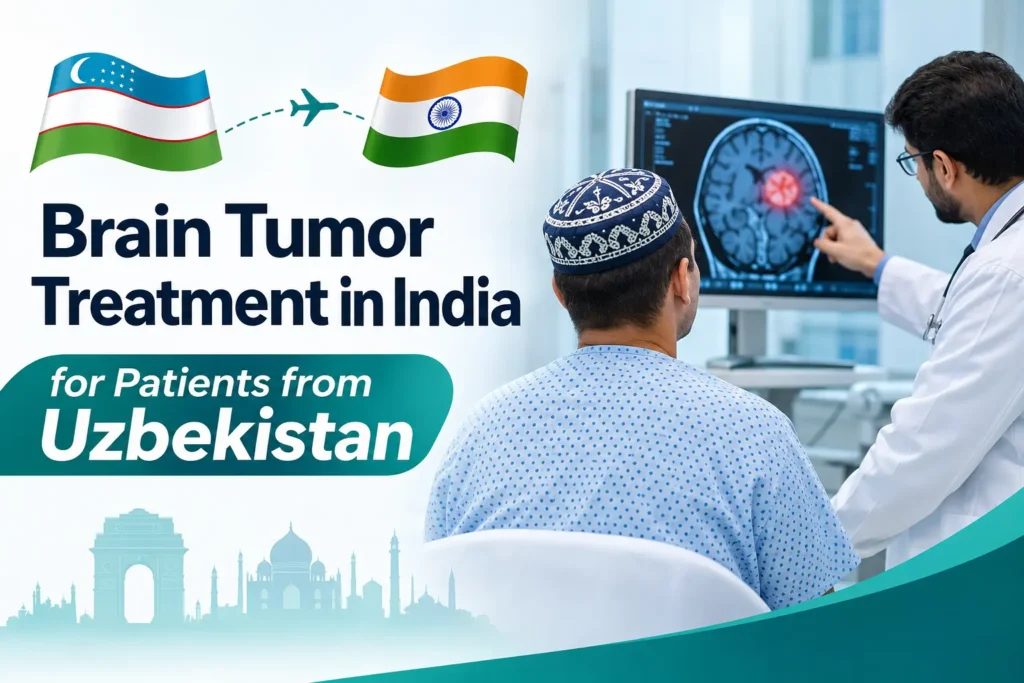
A brain tumor diagnosis often leaves patients and families with more questions than answers. Is the tumor benign or cancerous? Can it be removed? Is surgery the only option? This guide explains brain tumor treatment in India for patients from Uzbekistan: what a brain tumor is, which symptoms matter, how doctors diagnose it, which treatments exist, and how you can get an Indian neurosurgeon’s opinion from home before you decide anything.
Get Free Consultation Now
What Is a Brain Tumor?
A brain tumor is a growth of abnormal cells in the tissues of the brain. Tumors that start in the brain are called primary brain tumors. Tumors that start in another part of the body and spread to the brain are called metastatic brain tumors, and these are more common than primary ones. Up to half of metastatic brain tumors come from lung cancer.
Not every brain tumor is cancer. Benign tumors are not cancer. They grow and press on nearby areas of the brain, they rarely spread into other tissues, and they may come back. Malignant tumors are cancer, and they are likely to grow quickly and spread into other brain tissue. Both kinds cause symptoms and need treatment, because a tumor that presses on part of the brain can stop that part from working properly.
Doctors also give primary tumors a grade from I to IV, using the World Health Organization system. The grade is based on how abnormal the cells look under a microscope and how quickly the tumor is likely to grow and spread. Grade I brain tumors may be completely removed by surgery, while grade IV tumors usually cannot be completely removed by surgery. The grade is one reason two patients with a brain tumor can receive very different treatment plans.
Symptoms That Need a Doctor's Attention
The symptoms of a brain tumor are not the same in every person. They depend on where the tumor sits, what that part of the brain controls, and how large the tumor is. Symptoms can include a morning headache or a headache that goes away after vomiting, seizures, problems with vision, hearing or speech, loss of appetite, frequent nausea and vomiting, and changes in personality, mood, ability to focus or behavior. Some people notice loss of balance, trouble walking, weakness, or unusual sleepiness.
These symptoms can also be caused by other conditions, so they do not mean you have a tumor. They do mean you should see a doctor, and a scan is the only way to find out what is happening. If you have had any of these symptoms for some time, or they are getting worse, do not wait for them to settle on their own.
How Do Doctors Diagnose a Brain Tumor?
Diagnosis begins with your history and a physical exam. The doctor will usually do a neurological exam, which checks the brain, spinal cord and nerve function, including coordination, reflexes and walking. A visual field exam checks your range of vision, because loss of vision can be a sign that a tumor is pressing on the parts of the brain that affect eyesight.
Imaging then shows the tumor. A CT scan and an MRI with a contrast substance called gadolinium are the most common tests. In some cases the doctor also orders a PET scan or a SPECT scan, which help show how active the tumor cells are. If imaging suggests a tumor, a biopsy is usually done. A stereotactic biopsy uses a computer and a 3-D scanning device to guide a needle to a tumor deep in the brain. An open biopsy removes part of the skull in an operation called a craniotomy, and some or all of the tumor may be removed during the same surgery.
A pathologist then examines the tissue to find the type and grade of the tumor, and may run further tests such as immunohistochemistry and cytogenetic analysis. In some cases a biopsy or surgery cannot be done safely because of where the tumor sits. In others, the scans show that the tumor is very likely to be benign, and a biopsy is not needed. Your pathology report and scans are the most important papers for any second opinion.
Brain Tumor Treatment Options
The right treatment depends on the type and grade of the tumor, where it sits in the brain, whether surgery can remove it, whether cancer cells remain after surgery, whether there are certain changes in the chromosomes, whether it is newly diagnosed or has come back, and the patient’s general health. This is why brain tumor treatment in India, as anywhere else, starts with a full set of reports and not with a standard package. The main options are:
- Active surveillance: The doctor watches the tumor closely with regular exams and scans and treats only if it changes. It may be used for very slow-growing tumors that cause no symptoms.
- Surgery: Surgery is used to diagnose and treat brain tumors, and removing tumor tissue reduces the pressure on nearby parts of the brain. Before and during surgery, doctors can test brain function to find the areas around the tumor that matter most, so that they can remove as much of the tumor as possible with the least damage to normal brain tissue.
- Radiation therapy: High-energy rays kill tumor cells or stop them growing. Conformal radiation therapy and intensity-modulated radiation therapy shape the beams to the tumor to protect healthy tissue. Some patients receive radiation after surgery to kill any cancer cells that remain.
- Stereotactic radiosurgery: This does not involve an operation. A machine aims a single large dose of radiation directly at the tumor. For a grade I meningioma smaller than 3 centimeters, for example, radiosurgery is one of the treatment options.
- Chemotherapy: Drugs stop cancer cells from growing. Most chemotherapy drugs cannot cross the blood-brain barrier, but some can, and temozolomide is among the drugs used for brain tumors. In some cases a small wafer that dissolves is placed in the brain after surgery to deliver a chemotherapy drug directly to the tumor site.
- Targeted therapy: These drugs attack specific cancer cells. Bevacizumab is used for recurrent glioblastoma.
- Supportive care: Medicines to control seizures and swelling in the brain are part of treatment for many patients.
Two examples show how different the plans can be:
- Pilocytic astrocytoma (grade I): A slow-growing tumor, usually treated with surgery, with radiation added if some tumor remains.
- Glioblastoma (grade IV): May be treated with surgery followed by radiation therapy and chemotherapy given together, then chemotherapy alone.
Why Do Patients Seek an Indian Neurosurgeon's Opinion?
A brain tumor plan involves real choices: whether to operate, how much tumor to remove, and whether radiation or chemotherapy should follow. A second opinion can confirm your current plan, or it can show another option you had not considered. It does not replace your doctors in Bukhara, Uzbekistan or Tashkent. Your local scans, reports and treatment history are the starting point, and an Indian neurosurgeon will build on them.
How to Consult Indian Neurosurgeons from Uzbekistan
The quickest way is to send your reports to Medicsaz through our contact page for a medical opinion. You can also browse our doctors page.
For a brain tumor, gather the following papers before you write: your MRI scans on a disc or film, with the radiology report; any CT scans; the biopsy and pathology report, and the slides and tissue blocks if the laboratory can release them; PET or SPECT reports if you have had them; reports of any neurological or visual field exam; and a dated summary of treatment so far, including operation notes. Add a note of when the symptoms started and how they have changed, your current medicines, including seizure medicines, and any allergies. Send what you have now, and add the rest as you collect it.
Questions to Ask the Neurosurgeon
Write your questions down before the consultation. Ask whether the tumor is benign or malignant, and what its type and grade are. Ask whether it can be removed completely, and if not, what the aim of surgery would be. Ask whether radiosurgery, radiation therapy or chemotherapy is advised, in what order, and what side effects to expect. Ask whether active surveillance is reasonable in your case, what follow-up scans you will need, and which symptoms mean you should call the doctor urgently.
If the Doctor Recommends Treatment in India
If the specialist advises treatment in India, Medicsaz arranges the journey with you. We help with the medical visa, help you choose the hospital and doctor in Delhi and the surrounding region, and provide a translator and interpreter. Our panel has many hospitals with neurosurgery departments, and the right one depends on your reports. A few examples that offer brain tumor surgery are Sarvodaya Hospital in Faridabad, Manipal Hospital in Dwarka, Max Super Speciality Hospital in Saket, Indraprastha Apollo Hospital and BLK-Max Super Speciality Hospital, among others. Our team stays with you throughout the journey, we arrange airport pickup, and we help you choose accommodation. Visa rules and procedures can change, so our team confirms the current requirements with you when you apply.
Meet Indian Neurosurgeons at an OPD in Bukhara, Uzbekistan
If you would rather meet a neurosurgeon in person, Medicsaz is holding an OPD in Bukhara, Uzbekistan, where Indian doctors see patients with their reports. A Russian translator will be present.
OPD details
- City: Bukhara, Uzbekistan
- Date: 7th and 8th December 2026
Conclusion
Brain tumor treatment in India begins, like any good treatment plan, with your reports. The type and grade of the tumor, its position, and your general health decide whether you need surgery, radiosurgery, radiation therapy, chemotherapy, or careful watching. You can get an Indian neurosurgeon’s view without leaving Uzbekistan, by sending your scans and pathology report for an opinion or by meeting a visiting doctor at an OPD. If you or a family member has a brain tumor diagnosis or symptoms that worry you, visit our contact page to take the first step.
This article is general information. It is not a diagnosis and does not replace the advice of your doctor.
Frequently Asked Questions
Is every brain tumor cancer?
No. Benign brain tumors are not cancer, but they can still press on the brain and cause symptoms, so both benign and malignant tumors need treatment or close monitoring.
an a brain tumor be treated without open surgery?
Sometimes. Stereotactic radiosurgery does not involve an operation, and radiation therapy and chemotherapy are other options. Which one suits you depends on the type, size and position of the tumor, and your doctor decides this after reviewing your scans and pathology report.
Do I need to travel to India for an opinion?
No. You can send your reports to our team through our contact page for a medical opinion, or meet an Indian doctor at an OPD camp in Uzbekistan.
Will there be a translator?
Yes. A Russian translator is present at our OPD camps, including the one in Bukhara, Uzbekistan. If you travel to India for treatment, Medicsaz provides a translator and interpreter during your stay.
Is a consultation the same as starting treatment?
No. A consultation gives you a doctor’s view of your case. Any treatment, in India or at home, remains your decision.
Medically Reviewed
This page has been medically reviewed by Dr. Rashid Ali, MBBS, a Delhi Medical Council–registered practitioner (Registration No. DMC/R/36289), to ensure it reflects accurate, current, and evidence-based medical information.
At Medicsaz, every treatment page is checked by a licensed doctor before publication, not written by a marketing team alone. Dr. Rashid Ali review covers the accuracy of procedures, terminology, and claims described on this page, so patients researching can rely on what they read here to make informed decisions.
Last medically reviewed: 20/11/2026
You can independently verify Dr. Rashid Ali’s registration on the Delhi Medical Council’s official website using Registration No. DMC/R/36289, or read more about his role as Medicsaz’s medical reviewer on his reviewer profile page.