
LASIK / SMILE Treatment in India
Waking up and immediately fumbling around your nightstand just to find your glasses is an incredibly annoying daily ritual. If you wear contacts, you already know the pure panic of dropping one in the bathroom sink or dealing with dry, scratchy eyes at the end of a long workday. We usually just accept this terrible vision as a permanent life sentence.
Today, LASIK / SMILE Treatment in India has completely revolutionized how we fix bad eyesight. It isn’t experimental sci-fi anymore. It is a wildly fast, highly precise laser procedure that lets thousands of people permanently ditch their expensive frames and finally experience the world in high definition.
Get Free Consultation Now
What Is LASIK and SMILE Eye Surgery?
LASIK and SMILE are refractive eye surgeries. Basically, when you have bad vision, your eye is slightly wrong. Because of that weird shape, the light entering your eye bends incorrectly, making everything look blurry.
LASIK (Laser-Assisted In Situ Keratomileusis) and SMILE (Small Incision Lenticule Extraction) both use incredibly precise, computer-guided lasers to physically reshape the clear front dome of your eye, called the cornea. By perfectly flattening or steepening that tissue, the light finally hits your retina at the exact right angle. The final result is 20/20 vision, or sometimes even better, without a piece of plastic sitting on your face.
Who Is Suitable for LASIK / SMILE in India
Not everyone gets accepted for this. Eye surgeons are actually incredibly picky about who they operate on, and for good reason.
- Age requirement – You generally need to be over 18, and your vision prescription must be completely stable for at least a full year. If your eyes are still naturally changing, the surgery just won’t last.
- Cornea thickness – Because the laser literally vaporizes microscopic layers of tissue, you must naturally have a thick enough cornea to handle the procedure safely.
- Overall eye health – If you suffer from severe dry eye syndrome, cataracts, or advanced glaucoma, doctors will immediately tell you to skip this.
- Pregnancy – Hormones wildly mess with your fluid retention and physical eye shape. Women who are pregnant or nursing have to wait a few months.
Common Vision Problems Treated with LASIK / SMILE
These lasers are programmed to fix very specific mechanical errors in how you see the world.
- Nearsightedness (Myopia) – When you can read your phone perfectly fine, but the TV across the living room is a blurry mess.
- Farsightedness (Hyperopia) – The exact opposite of myopia is currently treated with LASIK, not SMILE. Distant objects look totally sharp, but trying to read a restaurant menu gives you a massive headache.
- Astigmatism – This condition occurs when the eye is shaped more elliptically rather than a perfectly spherical shape, resulting in severely distorted or elongated vision across most distances.
Tests Before LASIK / SMILE Treatment in India
A reputable clinic will absolutely refuse to touch you without running a massive battery of tests first. They need a flawless 3D map of your eye.
- Corneal topography – A topographical map that measures every single microscopic peak and valley on the surface of your eye.
- Pachymetry – A specialized ultrasound test to measure the exact physical thickness of your cornea down to the micron.
- Tear film analysis – Checking exactly how much moisture your eyes naturally produce to ensure you won’t suffer from crippling dry eyes post-surgery.
- Pupil measurement – Seeing exactly how wide your pupils dilate in the dark to prevent night-driving halos later on.
Recovery After LASIK / SMILE Surgery
The immediate recovery is basically just going home and taking a really long nap. When the numbing drops wear off on the car ride home, your eyes are going to burn and water heavily.
By the next morning, that pain is almost entirely gone. With LASIK, your vision is usually incredibly sharp within 24 hours. SMILE gets you functional vision within a day or two as well, though full stabilization can take a few weeks to a few months rather than settling immediately. You will have to wear incredibly attractive plastic shields taped over your eyes at night for a week so you don’t accidentally rub them in your sleep. And you will be practically bathing your eyes in artificial tears for a month.
Benefits of LASIK / SMILE Treatment
The perks are obvious, but they genuinely change how you live your daily life.
- Instant results – You literally walk into a clinic blind and walk out a few hours later with functional, independent vision.
- Financial savings – Add up the total cost of designer frames, prescription sunglasses, daily contacts, and contact solution over ten years. The surgery practically pays for itself.
- Total freedom – You can swim, play aggressive contact sports, or just fall asleep on the couch watching a movie without bending your expensive frames.
Risks and Side Effects of LASIK / SMILE
It is an elective surgery. Even with insanely advanced, multi-million dollar technology, there are always minor risks involved.
- Dry eyes – This is the absolute most common side effect. Your eyes will feel heavily irritated and dry for a few months while the severed surface nerves slowly heal.
- Halos and glare – Driving at night might look a little wild at first, with giant starbursts appearing around streetlights and oncoming cars. This usually fades over time.
- Flap complications – Only a risk with LASIK. If you rub your eye violently the day after surgery, you can actually wrinkle or dislodge the healing flap.
- Under-correction – Sometimes the laser doesn’t take off quite enough tissue, meaning you might still need a very weak pair of glasses for driving in the dark.
Life After LASIK / SMILE Surgery
Waking up and just seeing the alarm clock clearly is a total mind-trip for the first few weeks. You will probably still reach for your glasses on the nightstand purely out of habit.
Be extremely careful for the first month: no swimming in dirty lakes, no eye rubbing, and wear sunglasses outdoors for UV protection during cornea healing. After follow-up appointments and medical clearance, you’ll be fully unrestricted.
LASIK / SMILE Treatment in India Cost
LASIK / SMILE Treatment in India typically costs around $300 to $3,000 or more, depending on the procedure, laser technology, surgeon, hospital, and whether one or both eyes are treated. Standard LASIK is generally more affordable, while advanced procedures such as Femto-LASIK, Contoura Vision, SMILE, and SMILE Pro may cost more.
The exact cost depends on the type of laser procedure, preoperative eye examinations, corneal mapping, surgeon’s expertise, laser technology, hospital, medications, and postoperative follow-up. Customized treatments, advanced laser platforms, or treatment of both eyes may increase the overall cost. These figures are general estimates, not fixed quotes. Medicsaz can provide a personalized estimate after a partner ophthalmologist reviews the patient’s medical records and eye examination results.
How Medicsaz Supports Your LASIK / SMILE Treatment in India Journey
Medicsaz connects international patients with vetted partner hospitals and experienced ophthalmologists and refractive eye surgeons for LASIK / SMILE Treatment in India. The team assists with medical record review, hospital and specialist matching, treatment and cost estimates, travel and visa support, accommodation, and coordination throughout the patient’s treatment journey.
For patients exploring LASIK / SMILE Treatment in India, Medicsaz can help identify an appropriate refractive eye specialist and procedure based on the patient’s eye examination, prescription, corneal health, and clinical requirements.
Conclusion
Bad vision doesn’t have to be a permanent reality anymore. If you are completely exhausted by the daily, expensive hassle of contacts and glasses, this is your ticket out.
Today, LASIK / SMILE Treatment in India blends incredibly experienced refractive surgeons with the exact same high-end laser technology used anywhere else in the world. It takes a heavy initial investment and a little bit of courage to sit in that laser chair. But ask almost anyone who goes through with it, and they will tell you the exact same thing: I just wish I had done it ten years sooner.
Frequently Asked Questions
What's the main difference between LASIK and SMILE?
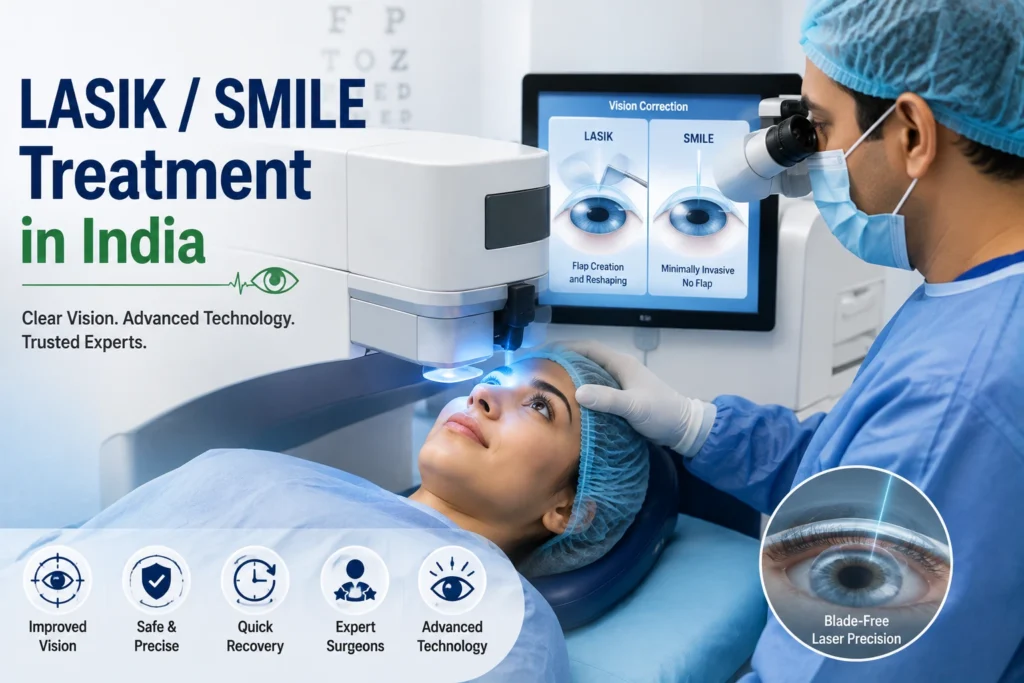
LASIK creates a corneal flap before reshaping the tissue underneath, while SMILE removes a tiny piece of tissue through a small incision without creating a flap — meaning SMILE eliminates flap-related risks entirely.
Am I a good candidate for LASIK or SMILE?
You generally need to be over 18 with a stable prescription for at least a year, adequate corneal thickness, and no significant dry eye, cataracts, or glaucoma — pregnant or nursing women are typically asked to wait.
Can SMILE treat farsightedness like LASIK can?
No — SMILE is currently used mainly for nearsightedness and astigmatism, while LASIK can treat nearsightedness, farsightedness, and astigmatism.
How long until my vision stabilizes after LASIK or SMILE?
LASIK typically delivers sharp vision within 24 hours, while SMILE also restores functional vision quickly but can take a few weeks to a few months to fully stabilize.
What are the most common side effects of LASIK or SMILE?
Temporary dry eyes are the most common side effect for both procedures, along with possible halos or glare around lights at night, which usually fade over the following months.
What tests are done before LASIK or SMILE surgery?
Doctors typically perform corneal topography to map the eye’s surface, pachymetry to measure corneal thickness, tear film analysis to check for dry eye risk, and pupil measurement to help predict night vision symptoms.
Medically Reviewed
This page on LASIK / SMILE Treatment in India has been medically reviewed by Dr. Rashid Ali, MBBS, a Delhi Medical Council–registered practitioner (Registration No. DMC/R/36289), to ensure it reflects accurate, current, and evidence-based medical information.
At Medicsaz, every treatment page is checked by a licensed doctor before publication, not written by a marketing team alone. Dr. Rashid Ali review covers the accuracy of procedures, terminology, and claims described on this page, so patients researching LASIK / SMILE Treatment in India can rely on what they read here to make informed decisions.
Last medically reviewed: 09/09/2026
You can independently verify Dr. Rashid Ali’s registration on the Delhi Medical Council’s official website using Registration No. DMC/R/36289, or read more about his role as Medicsaz’s medical reviewer on his reviewer profile page.