
Hernia Surgery in India
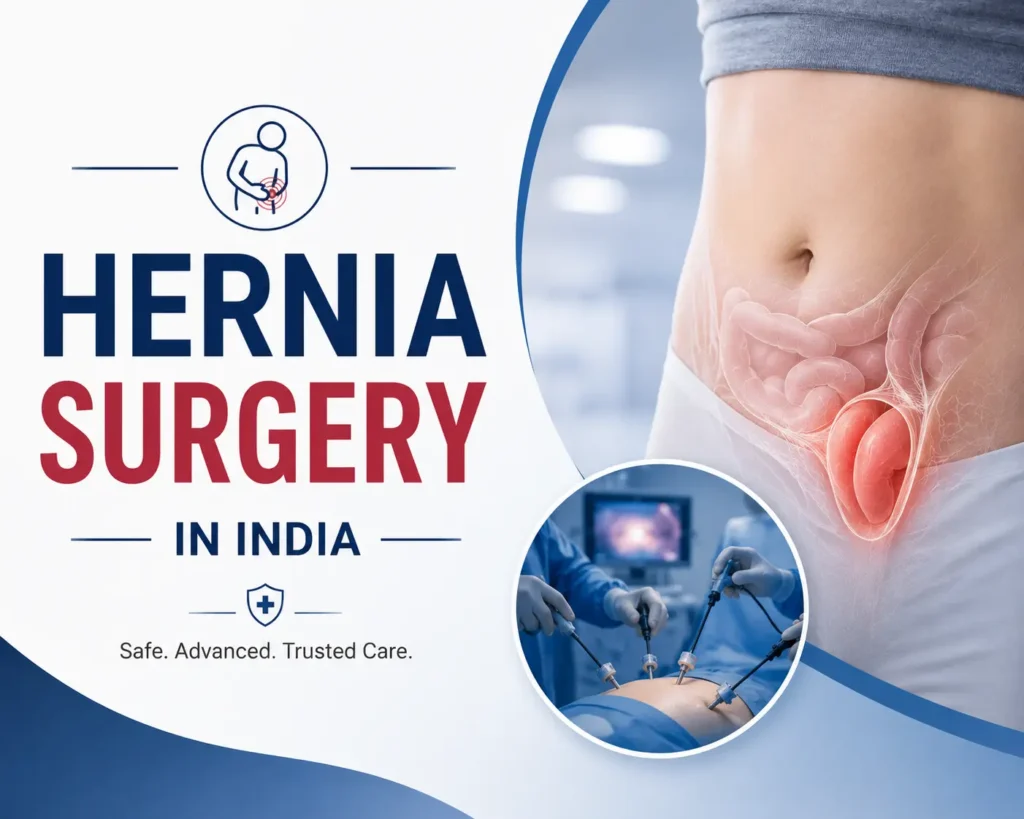
Detecting an abdominal lump becomes quite an unnerving procedure. This bump will take the form of a soft lump in the groin or belly button area, which becomes more pronounced with lifting weights, getting up quickly from a sitting position, and coughing. Although at first sight it may not seem like such a serious matter since the hernia shrinks away when you lie down, neglecting it will only result in it enlarging and causing even more discomfort.
A hernia happens when an organ or fatty tissues move out through an opening in the muscle wall due to its weakness. The muscle wall does not have any possibility of healing on its own, so, in order to get rid of the problem for good, surgery becomes inevitable. Luckily enough, in India nowadays, there are advanced techniques for hernia surgeries.
Get Free Consultation Now
What Is a Hernia?
A hernia occurs when internal pressure in the abdomen pushes tissue through a natural weak spot in the surrounding muscle. This allows underlying tissue, or sometimes a portion of the intestine, to bulge outward beneath the skin. This bulge can gradually enlarge over time with continued physical strain. If left untreated, in some cases, the pressure can restrict blood supply to the trapped tissue, turning a manageable condition into a medical emergency requiring urgent surgery.
Common Types of Hernia Explained
The particular form of a hernia is determined by where in the body there is muscle wall weakness:
- Inguinal Hernia: A hernia at the groin level. The most common form of a hernia. Occurs more often in men.
- Umbilical Hernia: A hernia around the area of the belly button.
- Hiatal Hernia: This hernia occurs when part of the stomach protrudes upward through an opening in the diaphragm. There is a different approach to treating this hernia, and further details can be provided by your surgeon.
- Incisional Hernia: Occurs in the scar tissue formed after an earlier operation in the abdomen.
Identifying the exact type and location of the hernia allows general surgeons to plan your Hernia Surgery in India with precision.
Causes and Risk Factors of Hernia
A hernia is a condition where the organs or fat tissue protrudes through weak muscle or connective tissues (fascia) due to excessive pressure on the abdomen along with muscle weakness. These are some important causes:
- Heavy physical strain: Heavy lifting while exercising and working puts a strain on your abdominal muscles.
- Straining: Coughing and constipation cause high pressure levels on the abdomen suddenly.
- Excess weight & multiple pregnancies: Obesity and pregnancy put strain on your abdominal muscles.
- Ageing: Tissue strength and elasticity get reduced naturally due to ageing.
- Incision from surgeries: Scars from abdominal surgeries make weak spots in the body than before.
Treatment Options for Hernia in India
Small, symptom-free hernias can sometimes be monitored with regular checkups rather than immediate surgery. However, for hernias causing symptoms or at risk of complications, surgery is generally recommended. Modern Hernia Surgery in India commonly uses synthetic mesh to reinforce the weakened muscle area, rather than relying solely on stitching the tissue back together, which tends to reduce the likelihood of the hernia returning compared to suture-only repair.
Laparoscopic and Open Hernia Surgery Explained
Surgeons choose between two main surgical approaches, depending on the size and location of the hernia. Open repair involves a single incision over the bulge to reposition the tissue and reinforce the wall from the outside.
Laparoscopic Hernia Surgery in India uses a few small incisions to insert a camera and specialized instruments, allowing the surgeon to repair the hernia from inside the abdominal wall with less disruption to the surrounding skin and tissue.
Mesh Repair in Hernia Surgery
Mesh repair is a widely used standard in modern hernia surgery. The surgeon places a flexible, biocompatible mesh patch over the weakened area, securing it to the surrounding healthy tissue. Over the following weeks, the body’s natural healing process integrates new tissue with the mesh, helping to reinforce the abdominal wall long-term.
Risks and Complications of Hernia Surgery
It is vital to know about the possible risks in advance. Chronic pain is by far the most frequent complication following mesh hernia repair surgery, which occurs in a rather high number of patients, caused by nerve irritation and the body’s response to the implant.
Other risks may include infections (sometimes necessitating the removal of the mesh), mesh migration or penetration into the surrounding tissues, adhesions potentially resulting in complications with the bowels, and fluid accumulation (seroma) at the operation site.
Although mesh repair surgery greatly minimizes the risk of hernia recurrence compared to sutures alone, it is still possible for various reasons such as smoking, obesity, and other medical problems.
Recovery After Hernia Surgery
Recovery after laparoscopic hernia repair is generally faster than after open surgery, though healing still takes time. Most people are able to walk comfortably within a few hours of surgery. For the first few weeks, it’s important to avoid heavy lifting or strenuous activity, and a high-fiber diet is often recommended to reduce straining during recovery.
Tips to Prevent Hernia Recurrence
Long-term management of the abdominal wall entails:
- Healthy Weight: Ensuring that a healthy weight is maintained to prevent undue pressure on the abdomen.
- Correct Posture During Heavy Lifting: Using the leg muscles during lifting of heavy objects rather than the abdominal muscles.
- Control of Coughs and Constipation: Controlling any chronic coughs or constipation to prevent any undue stress on the healing area.
Hernia Surgery in India Cost
Hernia Surgery in India typically costs around $1,200 to $4,500. The cost varies depending on the type and location of the hernia, surgical technique, hospital, surgeon, mesh used, preoperative investigations, anesthesia, hospital stay, and postoperative care.
The exact cost depends on the patient’s condition and treatment plan, including consultation, diagnostic tests, surgical and operating-room charges, mesh, anesthesia, medications, hospitalization, and follow-up care. These figures are general estimates, not fixed quotes. The final cost may vary depending on the hospital and complexity of the procedure.
How Medicsaz Supports Your Hernia Surgery in India Journey
Medicsaz connects international patients with vetted partner hospitals and experienced general surgeons for Hernia Surgery in India. The team assists with medical record review, hospital and surgeon matching, treatment and cost estimates, travel and visa support, accommodation, and coordination throughout the patient’s treatment journey in India.
For patients exploring Hernia Surgery in India, Medicsaz can help identify an appropriate surgeon and treatment approach based on the patient’s medical records, while providing guidance on expected costs and the overall treatment process.
Conclusion
A hernia represents a real structural weakness in the abdominal wall, but timely surgical repair can meaningfully improve comfort and quality of life for most patients. Choosing Hernia Surgery in India connects you with experienced surgical teams using modern laparoscopic techniques and mesh technology. By discussing the risks and benefits thoroughly with your surgeon and following recovery guidance closely, most patients are able to return to normal activity and see lasting relief from their symptoms.
Frequently Asked Questions
Is mesh hernia repair guaranteed to prevent recurrence?
No. Mesh significantly reduces the chance of the hernia returning compared to suture-only repair, but recurrence can still happen, particularly in patients who smoke, are obese, or have certain health conditions.
What is the most common complication after hernia mesh surgery?
Chronic pain is actually the most commonly reported complication, affecting a meaningful percentage of patients, more so than hernia recurrence itself. It’s important to discuss this risk with your surgeon beforehand.
Do all hernias need surgery right away?
Not necessarily. Small hernias without symptoms can sometimes be monitored with regular checkups, while surgery is generally recommended for hernias causing pain or at risk of complications.
Is laparoscopic or open hernia surgery better?
It depends on the size, location, and complexity of the hernia. Laparoscopic surgery generally offers a faster recovery with smaller incisions, while open surgery may be preferred for larger or more complex hernias.
Can a hiatal hernia be treated the same way as a groin or umbilical hernia?
No. Hiatal hernias involve the diaphragm and stomach rather than the abdominal wall muscles, and are often treated differently, sometimes with a procedure called fundoplication. Your surgeon can explain the best approach for your specific type of hernia.
How soon can I return to normal activity after hernia surgery?
Many patients can walk comfortably within hours of surgery, but heavy lifting and strenuous activity are typically avoided for several weeks to protect the healing repair.
Medically Reviewed
This page on Hernia Surgery in India has been medically reviewed by Dr. Rashid Ali, MBBS, a Delhi Medical Council–registered practitioner (Registration No. DMC/R/36289), to ensure it reflects accurate, current, and evidence-based medical information.
At Medicsaz, every treatment page is checked by a licensed doctor before publication, not written by a marketing team alone. Dr. Rashid Ali review covers the accuracy of procedures, terminology, and claims described on this page, so patients researching Hernia Surgery in India can rely on what they read here to make informed decisions.
Last medically reviewed: 09/09/2026
You can independently verify Dr. Rashid Ali’s registration on the Delhi Medical Council’s official website using Registration No. DMC/R/36289, or read more about his role as Medicsaz’s medical reviewer on his reviewer profile page.