
Electrophysiology Study (EPS) in India
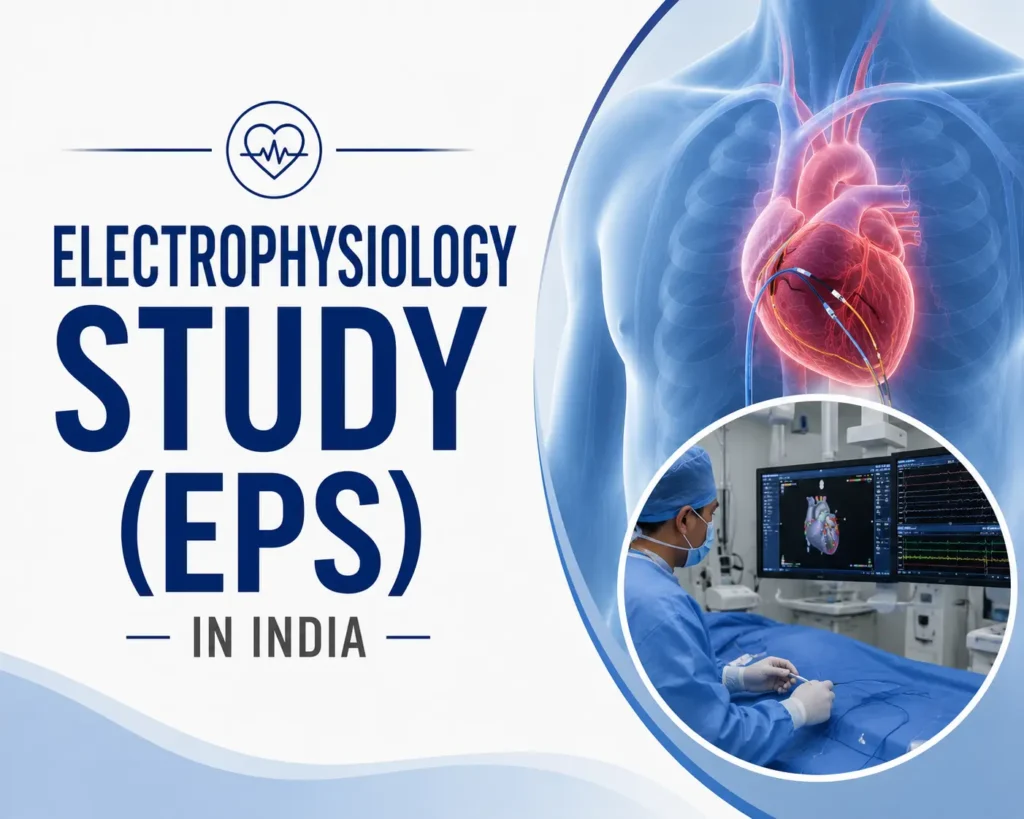
Not all cardiac issues show on a standard test. There are cases where some people experience sudden heart palpitations, dizzy spells, or even blackouts, but the results of their ECG or any standard report turn out to be completely normal. The frustration is understandable because there is definitely something wrong with the patient, but the usual tests could not detect that.
It is at this point that doctors investigate further the mechanism of firing of the electrical impulses of the heart. That is when an electrophysiology study is performed to pinpoint the actual cause of the abnormal heartbeat without any guessing. Nowadays, the Electrophysiology Study (EPS) in India is widely done for diagnosis and treatment of rhythm problems.
Get Free Consultation Now
What Is an Electrophysiology Study (EPS)?
An electrophysiology study is a specialized test that checks how electrical signals move through the heart. These signals control the timing of each heartbeat, and any disturbance in them can cause an abnormal rhythm. During the test, thin flexible wires are guided into the heart to record electrical activity and find exactly where the problem starts.
When Is EPS Recommended for Heart Rhythm Problems
EPS is not the first choice for an initial assessment of heart health. This procedure is prescribed only if other tests cannot explain some particular symptoms:
- Faintness: Losing consciousness without clear causes according to regular reports
- Palpitation: Experiencing palpitations that cannot be detected by regular ECG methods
- Ablation Procedure: Preparing for the correction of the heart’s electrical system prior to its performance
Causes of Abnormal Heart Rhythms
Heart rhythm problems can have several different causes:
- Past Heart Damage: Existing heart disease or old scar tissue that creates an abnormal electrical pathway
- Chemical Imbalance: Stress or electrolyte shifts that affect the heart’s electrical signals
- Structural Issues: Heart defects present from birth that affect normal electrical conduction
Tests Before Electrophysiology Study (EPS) in India
Before an EPS, doctors usually complete a few basic evaluations first:
- ECG: Records the heart’s rhythm at a single moment to look for obvious abnormalities
- Holter Monitor: A wearable device that tracks heart rhythm over 24 hours or longer during normal activity
- Echocardiography: An imaging test that checks the heart’s physical structure and pumping function
EPS Procedure Explained Step by Step
The test is performed in a laboratory environment and generally does not involve general anesthesia. A catheter is placed in the groin area, and wires are positioned inside the heart. The wires can measure the heart’s electrical activity and can help doctors analyze the heart’s response to certain stimuli. In some instances, doctors will induce a specific rhythm in order to pinpoint its origin.
EPS and Catheter Ablation: How They Are Related
In many cases, EPS isn’t just for finding the problem; it’s also used to treat it in the same session. If the exact source of the abnormal rhythm is found, doctors can perform catheter ablation, using heat or cold energy to target the small area causing the faulty signals.
It’s worth understanding that ablation success varies significantly depending on the type of arrhythmia being treated. For rhythm problems like SVT, single-procedure success rates are typically very high. For atrial fibrillation specifically, results are less predictable. Many patients see real improvement, but a meaningful number need a second or even third ablation procedure over time to achieve lasting results. Your electrophysiologist can give you a realistic picture based on your specific rhythm problem.
Risks and Complications of EPS
EPS is generally considered very safe, but like any procedure involving the heart, it carries some minor risks:
- Localized Bleeding: Minor bruising or bleeding at the site where the wires entered
- Rhythm Changes: Temporary rhythm shifts during the test as doctors probe the heart’s electrical system
- Vessel Injury: Very rare cases of blood vessel damage, closely monitored by the clinical team
Recovery After Electrophysiology Study
Recovery from this procedure is typically straightforward and quick. Most patients are monitored for a few hours afterward to confirm everything is stable. There may be some tenderness at the site where the catheter was placed, but most people return to normal activities within a couple of days. Heavy lifting should be avoided until the site has fully healed.
Long-Term Monitoring After EPS
After the procedure, follow-up visits are important to make sure the heart’s rhythm stays stable. If ablation was performed, many patients see their symptoms improve significantly or stop entirely, especially for rhythm problems like SVT. Regular checkups help specialists confirm the heart remains stable and catch any recurrence early, which is particularly important for AFib patients given the higher likelihood of needing a repeat procedure.
Electrophysiology Study (EPS) in India Cost
Electrophysiology Study (EPS) in India typically costs around $450 to $2,600. The cost varies depending on the hospital, electrophysiologist, complexity of the study, diagnostic equipment, catheter and laboratory charges, anesthesia or sedation, hospital stay, and follow-up care.
The exact cost depends on pre-procedure cardiac evaluation, ECG and other diagnostic tests, electrophysiology laboratory charges, catheterization, monitoring, medications, hospitalisation or observation, and follow-up care. These figures are general estimates, not fixed quotes. Medicsaz can provide a personalized cost estimate after a partner cardiac specialist reviews the patient’s medical records and treatment requirements.
How Medicsaz Supports Your Electrophysiology Study (EPS) in India Journey
Medicsaz connects international patients with vetted partner hospitals and experienced cardiac electrophysiologists for Electrophysiology Study (EPS) in India. The team assists with medical record review, hospital and specialist matching, treatment and cost estimates, travel and visa support, accommodation, and coordination throughout the patient’s treatment journey in India.
For patients exploring Electrophysiology Study (EPS) Treatment in India, Medicsaz can help identify an appropriate cardiac electrophysiologist and treatment approach based on the patient’s medical records, while providing guidance on expected costs and the overall treatment process.
Conclusion
Electrophysiology studies help solve the problem of symptoms that don’t have clear answers from basic tests. Instead of relying on guesswork, this tool gives doctors a detailed map of the heart’s electrical activity and how it’s misfiring. Electrophysiology Study (EPS) in India provides an accurate diagnosis and, when combined with ablation, an effective path toward better rhythm control, though the likelihood of a lasting result on the first attempt depends on the specific type of arrhythmia involved. With proper follow-up, patients can manage their rhythm problems and return to a stable daily life.
Frequently Asked Questions
Is catheter ablation always successful after just one procedure?
Not always — success rates vary by arrhythmia type. SVT ablation typically has very high single-procedure success, while atrial fibrillation ablation is less predictable and sometimes requires a second or third procedure for lasting results.
Does EPS require general anesthesia?
No — EPS is typically done under local anesthesia with sedation, not general anesthesia, and patients remain conscious throughout the procedure.
How is EPS different from a regular ECG?
A regular ECG records a brief snapshot of heart rhythm from outside the body, while EPS uses wires placed directly inside the heart to map exactly where an electrical problem originates.
Can EPS both diagnose and treat rhythm problems in the same session?
Yes — if the source of an abnormal rhythm is identified during EPS, doctors can often proceed directly to catheter ablation to treat it in the same procedure.
How long does it take to recover from an EPS procedure?
Most patients are monitored for a few hours after the procedure and can return to normal activities within a couple of days, avoiding heavy lifting until the insertion site heals.
What symptoms might lead a doctor to recommend an EPS?
Unexplained fainting, persistent palpitations not captured on standard ECG, or the need for detailed mapping before an ablation procedure are common reasons for recommending EPS.
Medically Reviewed
This page on Electrophysiology Study (EPS) in India has been medically reviewed by Dr. Rashid Ali, MBBS, a Delhi Medical Council–registered practitioner (Registration No. DMC/R/36289), to ensure it reflects accurate, current, and evidence-based medical information.
At Medicsaz, every treatment page is checked by a licensed doctor before publication, not written by a marketing team alone. Dr. Rashid Ali review covers the accuracy of procedures, terminology, and claims described on this page, so patients researching Electrophysiology Study (EPS) in India can rely on what they read here to make informed decisions.
Last medically reviewed: 09/09/2026
You can independently verify Dr. Rashid Ali’s registration on the Delhi Medical Council’s official website using Registration No. DMC/R/36289, or read more about his role as Medicsaz’s medical reviewer on his reviewer profile page.