
Esophageal Cancer Treatment in India
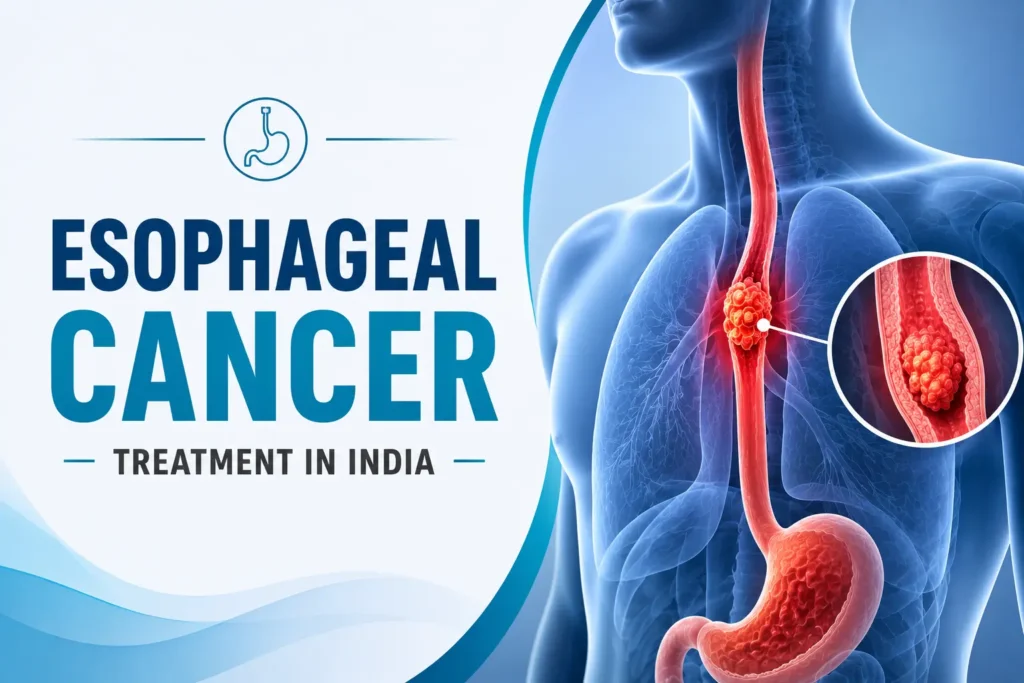
In the highly specialized area of oncology pertaining to the digestive system, esophageal cancer treatment in India is an extremely precise medical procedure. It is a disease that develops in the food pipe, which acts as the tube for the transport of food into the stomach from the mouth. More often than not, esophageal cancer starts developing quite silently until swallowing itself becomes difficult.
As it is not a commonly talked about cancer, any early symptoms are neglected by the patient because of their seemingly harmless nature, like acidity and chest pressure. Early detection is the key to normal swallowing and nutrition.
Get Free Consultation Now
What Is Esophagus Cancer?
Esophagus cancer is a disease in which there is abnormal cell growth in the inner lining of the food pipe. The food pipe is the muscular part of the body through which food passes from the mouth to the stomach. These abnormal cell growths may cause a blockage in the food passage.
Early Signs and Symptoms of Esophageal Cancer
The signs of this condition are often subtle at first. Specialists watch for several specific red flags:
- Swallowing Difficulty: A persistent feeling of food being stuck, or trouble swallowing solid foods.
- Chest Discomfort: Constant pressure or burning in the chest that doesn’t resolve with standard remedies.
- Unexplained Weight Loss: A sign that shouldn’t be ignored.
- Frequent Vomiting or Regurgitation: A sense that food isn’t going down properly.
Universal Causes and Risk Factors
Insight into the global risk factors of this illness is important to both prevent and detect it early. Though genes may be implicated in some cases, environment and lifestyle factors are key:
- Tobacco and Alcohol: Any type of tobacco product usage, such as smoking and non-smoking kinds of tobacco, continues to be one of the greatest risk factors globally. Also, regular drinking aggravates the risks tremendously.
- Chronic Reflux (GERD): Chronic reflux may hurt the lining of the esophagus, eventually causing Barrett’s Esophagus – a precursor to adenocarcinoma.
- Lifestyle Factors: Being obese and eating foods that lack fresh fruits and vegetables are high-risk factors. Plus, drinking beverages too hot can cause harm to the esophagus.
How Esophageal Cancer Is Diagnosed
Doctors in India use a combination of visual examination and tissue sampling to diagnose esophageal cancer accurately:
- Endoscopy: A camera is used to directly examine the lining of the esophagus.
- Biopsy: During endoscopy, a small tissue sample is taken and examined under a microscope — this is the step that actually confirms a cancer diagnosis.
- CT Scans: Provide a detailed 3D map to assess the tumor’s size and whether it has spread.
Stages of Esophageal Cancer Explained
Classification of esophageal cancer is done according to the depth of invasion of the primary tumor, as well as lymph nodes and metastasis dissemination. Depending on the medical staging system, the following stages are established:
- Stage 0 (Carcinoma In Situ): Pre-malignant or abnormal cells affect only the epithelial lining of the esophageal wall without penetration into the deeper layers.
- Stage I (Localized Carcinoma): The tumor passes beyond the lining (epithelial) membrane of the esophageal wall and affects the lamina propria, submucosa, or the muscularis layer of the esophagus without metastasizing to nearby lymph nodes or to any other distant organs of the body.
- Stages II & III (Advanced Localized Carcinoma): The growth of the invasive form of the tumor penetrates the adventitial layer of the esophageal wall and/or surrounding tissues. This means that at this stage of development, the metastases will affect the lymph nodes in the chest and abdominal regions but not beyond this area.
- Stage IV (Advanced Metastatic Carcinoma): Cancer cells will spread to the body organs via lymph channels or blood.
It’s worth knowing that exact staging criteria are complex and vary depending on the specific type of esophageal cancer (squamous cell carcinoma vs. adenocarcinoma) and other tumor characteristics. This overview is simplified for general understanding; your oncologist will explain your specific stage and what it means for your treatment plan.
Planning for Esophageal Cancer Treatment in India
The treatment strategy will be based on the type and stage of the tumor along with the general condition of the body. Specialized doctors from one of the best Indian medical institutes work collectively to design an individual treatment plan with maximum accuracy for protection of all adjacent structures of the heart and lungs.
Surgery for Esophageal Cancer
The procedure of surgery (esophagectomy) is frequently employed as the most common approach in the removal of part of the esophagus and the joining of the remaining portion to the stomach. It is important to realize in advance that esophagectomy is a very serious and complicated procedure with a significant recovery process, where patients usually require a temporary feeding tube (jejunostomy) after the procedure due to the healing period and the extended stay in the hospital compared to other cancer surgeries.
Chemotherapy and Radiation Therapy
For advanced stages, chemotherapy and radiation therapy are used, often together, to destroy remaining cancer cells. These treatments are carefully targeted to protect nearby healthy tissue, though they can cause temporary side effects such as fatigue, difficulty swallowing, or nausea, which your care team will help manage. Chemotherapy also helps reach cancer cells that may have spread beyond the primary site.
Recovery and Follow-Up Care
The period of recovery depends on the degree of damage to the esophagus from the treatment method used. Recovery implies adjustment of the digestive system of the patient to eating and the introduction of food from liquids to solids. Continuous follow-ups and scans are required in order to monitor the condition of the patient.
- Early Period of Recovery: The first period of recovery after surgery when the organism adjusts to the change in its digestive function.
- Follow-up Scans: Follow-up scanning for possible recurrence.
- Adjusting the Diet: Adjusting food intake gradually with the help of small portions.
Diet and Lifestyle After Treatment
After treatment, small, frequent meals are often easier to manage than large ones, and a dietitian can help guide this adjustment. Avoiding tobacco and alcohol is essential to protect the healed tissue and reduce the risk of recurrence.
Esophageal Cancer Treatment in India Cost
Esophageal Cancer Treatment in India typically ranges from around $3,000 to $18,000. The cost varies depending on the stage and location of the cancer, treatment approach, surgery, chemotherapy, radiation therapy, hospital, specialist, diagnostic tests, hospital stay, and other patient-specific requirements.
The exact cost depends on biopsy and staging investigations, endoscopy, imaging, esophagectomy when required, chemotherapy, radiation therapy, immunotherapy, hospitalisation, medications, and follow-up care. These figures are general estimates, not fixed quotes. Medicsaz can provide a personalized cost estimate after a partner oncology team reviews the patient’s medical records and treatment requirements.
How Medicsaz Supports Your Esophageal Cancer Treatment in India Journey
Medicsaz connects international patients with vetted partner hospitals and experienced gastrointestinal, thoracic, and oncology specialists for Esophageal Cancer Treatment in India. The team assists with medical record review, hospital and doctor matching, treatment and cost estimates, travel and visa support, accommodation, and coordination throughout the patient’s treatment journey in India.
For patients exploring Esophageal Cancer Treatment in India, Medicsaz can help identify an appropriate cancer specialist and treatment approach based on the patient’s diagnosis and medical records, while providing guidance on expected costs and the overall treatment process.
Conclusion
Ignoring difficulty swallowing or persistent chest discomfort is a risk not worth taking. Esophageal cancer treatment in India offers advanced diagnostic and treatment tools, along with regular follow-up, to support patients through a serious diagnosis. Modern, coordinated care offers a clear and reliable path back to health.
Frequently Asked Questions
What are the early warning signs of esophageal cancer?
The most common early sign is difficulty swallowing, especially with solid foods, along with persistent chest discomfort, unexplained weight loss, or frequent regurgitation. Because early esophageal cancer can also cause vague symptoms like acidity, persistent symptoms lasting more than a few weeks should be evaluated by a doctor.
Is chewing tobacco a risk factor for esophageal cancer?
Yes — smokeless tobacco, including pan and gutka, is a well-documented and significant risk factor for esophageal cancer in India, alongside smoking and alcohol use. Regular consumption of very hot beverages has also been linked to increased risk in Indian studies.
Will I need a feeding tube after esophageal cancer surgery?
Many patients receive a temporary feeding tube (usually a jejunostomy) after esophagectomy to support nutrition while the surgical site heals, since eating normally isn’t possible right away. This is a standard, well-established part of recovery for many patients and is typically removed once oral eating is re-established.
How is esophageal cancer actually diagnosed?
Diagnosis typically starts with an endoscopy to directly view the esophagus, followed by a biopsy — where a tissue sample is examined under a microscope — to confirm whether cancer is present. CT scans are then used to assess the tumor’s size and check whether it has spread.
How long is recovery after esophagectomy?
Esophagectomy is major surgery, so recovery typically takes several weeks in the hospital and beyond, with a gradual return to eating solid foods over time. Your care team will guide you through dietary changes step by step, often starting with liquids and slowly progressing as healing continues.
Is esophageal cancer curable?
Outcomes depend heavily on the stage at diagnosis — cancer caught while still confined to the esophagus has a better chance of successful treatment, while outcomes become more challenging once it has spread further. This is why evaluating persistent swallowing difficulty or chest symptoms early makes a meaningful difference.
Medically Reviewed
This page on Esophageal Cancer Treatment in India has been medically reviewed by Dr. Rashid Ali, MBBS, a Delhi Medical Council–registered practitioner (Registration No. DMC/R/36289), to ensure it reflects accurate, current, and evidence-based medical information.
At Medicsaz, every treatment page is checked by a licensed doctor before publication, not written by a marketing team alone. Dr. Rashid Ali review covers the accuracy of procedures, terminology, and claims described on this page, so patients researching Esophageal Cancer Treatment in India can rely on what they read here to make informed decisions.
Last medically reviewed: 09/09/2026
You can independently verify Dr. Rashid Ali’s registration on the Delhi Medical Council’s official website using Registration No. DMC/R/36289, or read more about his role as Medicsaz’s medical reviewer on his reviewer profile page.