
Kidney Stone Removal in India
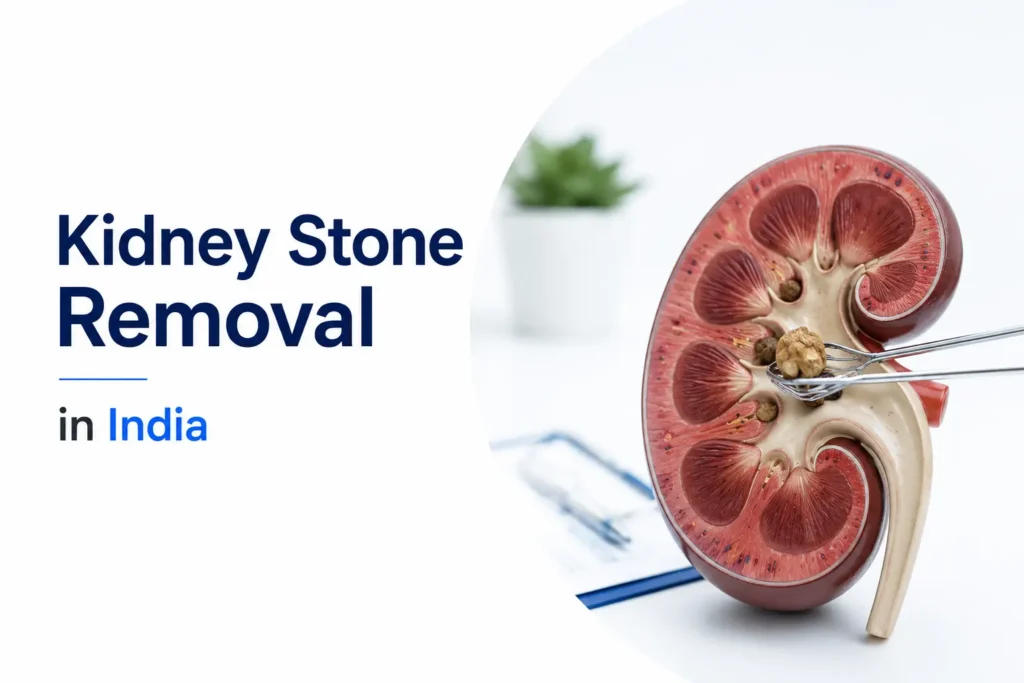
Dealing with sudden, sharp back pain can be an alarming experience. Doesn’t matter if a person is perfectly healthy or has a history of dietary issues. A sudden ache in the side or lower back, or a heavy pain shifting toward the abdomen. At first, almost everyone ignores it. People drink extra water, take a standard painkiller, and just try to wait it out.
But when that sharp ache completely refuses to fade and actually starts causing severe discomfort and nausea, patients have a real problem. That is exactly when they need to stop guessing. Kidney Stone Removal in India has completely shifted in the last few years, moving away from major open surgeries to offering highly specialized, minimally invasive procedures that clear the blockage without permanent damage or prolonged bed rest.
Get Free Consultation Now
What Are Kidney Stones?
A kidney stone means minerals and salts have crystallized and clumped together inside the structural parts of the kidneys. Sometimes the buildup happens in one sudden event. Other times, it is a slow burn, crystals that build up after months of low hydration and heavy dietary stress on the same organs.
Minor stones usually fade after a few days of heavy fluid intake, but the more severe ones require actual medical intervention, and often kidney stone removal in India through one of the minimally invasive procedures described below.
Common Symptoms of Kidney Stones
What a patient ends up feeling heavily depends on how large the stone grows and where it travels. People often feel severe, sharp pain in the back or side. The pain may shift directly toward the lower abdomen and groin. Burning sensations while passing urine, a frequent urge to urinate, or seeing blood in the urine are common signs. These symptoms are seen constantly in patients dealing with dehydration or high sodium diets.
Causes of Kidney Stones in India
Kidney stones can develop due to several reasons, often related to lifestyle and daily habits.
- Low water intake: less fluid in the body increases the concentration of minerals in the urine.
- High salt or protein diet: excess intake can actively increase the rate of stone formation.
- Family history: genetic factors that can raise the likelihood of stone formation.
- Certain medical conditions: conditions like obesity or metabolic disorders that disrupt how the body processes minerals.
Types of Kidney Stone Removal Treatments in India
How a patient gets treated completely depends on how badly the stone is blocking the urinary tract. For mild cases, the doctor will probably recommend the standard routine of heavy hydration and specific medications.
But when things get serious, patients face heavier interventions. This includes shock wave therapy (ESWL) to break the stones from outside the body, Ureteroscopy (URS) to retrieve them with a small scope, or PCNL procedures for larger stones. Modern kidney stone removal in India isn’t just about killing the pain, it is about clearing the mechanical blockage safely.
Kidney Stone Removal Procedures Explained
During a ureteroscopy, a thin tube with a camera goes in first to see the stone clearly on a monitor. Special instruments carefully break or remove the stone without damaging the surrounding tissue. The muscles and surrounding organs remain mostly unaffected by the process.
For larger stones, a PCNL is performed under general anesthesia. The surgeon makes one small cut in the back measuring just 1 to 2 centimeters. The stone is removed through this small opening with minimal damage to nearby tissue. The removal portion of a kidney stone removal procedure in India typically takes roughly 1 to 3 hours depending on stone size and technique used.
Tests Before Kidney Stone Treatment in India
Doctors don’t guess where the stone is stuck. Imaging comes first, to see exactly where the blockage is and how significant it is.
- Ultrasound: detects the presence and size of stones.
- CT scan: provides detailed information about the location and number of stones.
- Urine test: checks for infection and mineral levels.
- Blood tests: evaluate kidney function and overall health.
These tests give the medical team what they need to plan treatment accurately.
Recovery After Kidney Stone Removal
How long patients need to recover depends entirely on the procedure. A simple ESWL or URS might have them back to normal routines in a few days. A PCNL procedure typically takes a couple of weeks of rest.
Following medical advice, increasing water intake, and taking prescribed medications all affect how fast patients heal. Rushing back to heavy physical activity before being formally cleared raises the risk of complications. Patients typically return to normal activity once the doctor confirms they’re ready.
Diet and Prevention of Kidney Stones
Surgery might clear the physical blockage, but dietary changes are what actually reduce the chance of stones coming back. This matters for keeping the kidneys functioning well long term.
A doctor will typically guide patients through specific dietary changes designed to limit sodium and animal protein. Following this routine consistently is generally the biggest factor in long term prevention.
Risks and Complications of Kidney Stone Treatment
Though generally quite safe when performed by experienced surgeons, these procedures still carry some potential risks.
In the initial weeks following the procedure, patients may experience minor infections or the natural passing of small, residual stone fragments. Temporary discomfort, mild cramping, and minor blood in the urine are also common in the first few days. Physicians provide close monitoring during recovery to catch and manage any complications early.
Kidney Stone Removal Cost in India
Cost depends heavily on which procedure is needed. As a general guide for international patients: ESWL, the least invasive option, typically costs $400 to $800. Ureteroscopy (URS) typically runs $500 to $2,000. PCNL, used for larger or more complex stones, typically costs $3,000 to $4,500, with more complex cases sometimes running higher.
The exact figure depends on stone size, number, location, the hospital chosen, and length of stay. These are general figures, not fixed quotes. Medicsaz can put together a personalized cost estimate once a partner urologist has reviewed your imaging.
How Medicsaz Supports Your Kidney Stone Removal Journey in India
Medicsaz connects you with vetted partner hospitals and urologists experienced in kidney stone removal, and coordinates everything around the procedure, cost estimates, medical records review, hospital and doctor matching, travel and visa support, accommodation, and a point of contact throughout your stay in India.
If you’re ready to explore kidney stone removal in India, reach out for a free medical opinion and cost estimate. Most inquiries get a response within 30 minutes.
Life After Kidney Stone Removal
Making it through treatment and returning to a normal routine is a good feeling. However, patients shouldn’t simply forget the episode and instantly return to their previous diet.
Doctors generally recommend keeping up with hydration and paying close attention to salt intake going forward. Follow up appointments help confirm the kidneys are clear and functioning normally without new stones forming.
Conclusion
Ignoring severe kidney stone pain is unwise, early and proper treatment helps prevent complications. Modern kidney stone removal in India uses advanced, tissue sparing care like shock wave therapy and minimally invasive surgery. With proper hydration and the right medical treatment, many patients are able to return to their normal routine without chronic pain.
Frequently Asked Questions
What's the difference between ESWL, URS, and PCNL for kidney stones?
ESWL uses shock waves from outside the body to break up stones, URS uses a small scope inserted through the urinary tract to remove or break stones, and PCNL is used for larger stones, requiring a small incision in the back for direct removal.
Do all kidney stones require surgery?
No, small stones often pass on their own with increased hydration and medication. Surgery is typically reserved for stones that are too large to pass naturally or are causing a significant blockage.
What causes kidney stones to form?
Common causes include low water intake, a high salt or high protein diet, family history, and certain metabolic conditions that affect how the body processes minerals.
How can I prevent kidney stones from coming back?
Staying well hydrated and limiting sodium and animal protein intake are the biggest factors in reducing recurrence, along with any specific dietary guidance based on your stone type.
Can kidney stones come back after treatment?
Yes, recurrence is common without dietary changes, which is why doctors emphasize hydration and reduced sodium and protein intake as part of long term prevention.
What are the warning signs that a kidney stone needs urgent treatment?
Severe pain that doesn’t improve, persistent nausea, blood in the urine, or fever alongside stone symptoms are signs that warrant prompt medical evaluation.
What's the largest kidney stone that can be treated without surgery?
This depends on stone location and composition, but generally, larger or harder stones are less responsive to non-surgical options like ESWL and may need URS or PCNL instead.
Medically Reviewed
This page on Kidney Stone Removal in India has been medically reviewed by Dr. Rashid Ali, MBBS, a Delhi Medical Council–registered practitioner (Registration No. DMC/R/36289), to ensure it reflects accurate, current, and evidence-based medical information.
At Medicsaz, every treatment page is checked by a licensed doctor before publication, not written by a marketing team alone. Dr. Rashid Ali review covers the accuracy of procedures, terminology, and claims described on this page, so patients researching Kidney Stone Removal in India can rely on what they read here to make informed decisions.
Last medically reviewed: 09/09/2026
You can independently verify Dr. Rashid Ali’s registration on the Delhi Medical Council’s official website using Registration No. DMC/R/36289, or read more about his role as Medicsaz’s medical reviewer on his reviewer profile page.