
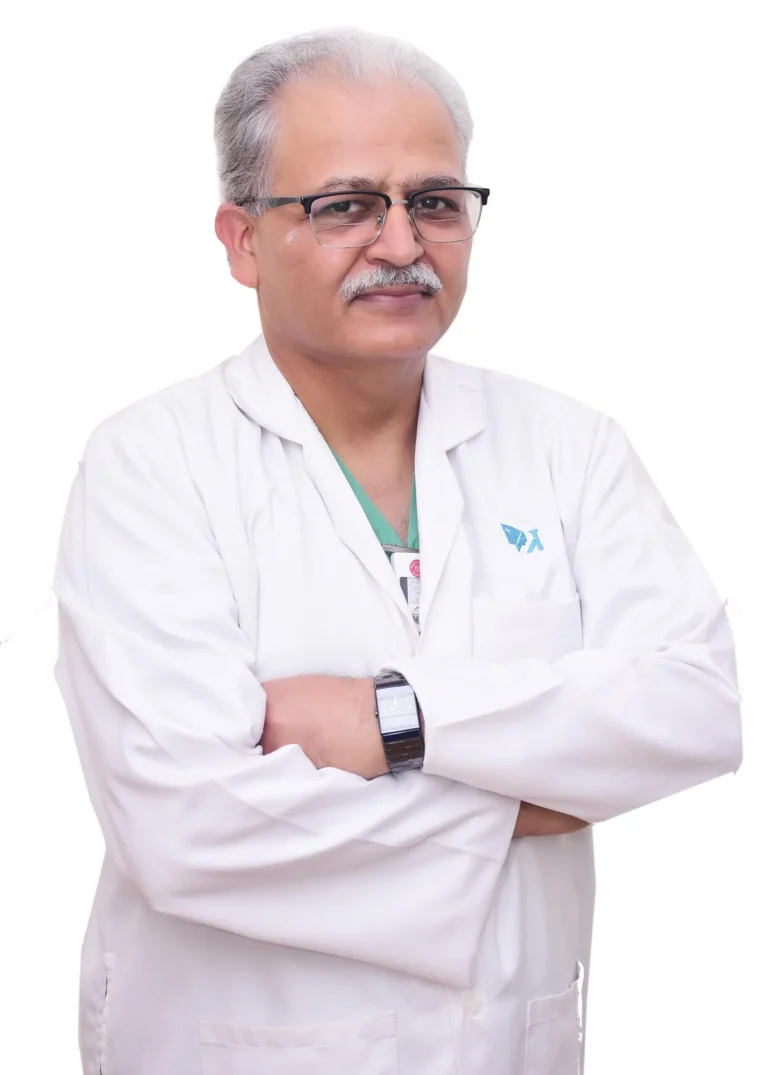
Dr. Rakesh Mahajan
Experience: Over 36 years
Indraprastha Apollo Hospital
New Delhi, India
Introduction
Dr. Rakesh Mahajan does vascular and endovascular surgery at Indraprastha Apollo. Been here since 2004, two decades building the vascular department into what it is today. Patients present with blocked leg arteries, a dangerous aortic aneurysm, varicose veins, deep vein blood clots, or a failed dialysis fistula with no alternative access.
About Dr. Rakesh Mahajan
Dr. Rakesh Mahajan did MBBS and MS both from AIIMS, New Delhi. He earned the CCST, which is the British certification that says you’ve completed specialist training and are qualified to practice independently as a consultant. Actually worked as a Consultant Surgeon at Royal Gwent Hospital in Wales in the NHS, treating British patients under the British system.
He does vascular work, which includes minimally invasive endovascular procedures like EVAR and TEVAR for aortic aneurysms. It also covers carotid stenting/surgery for stroke prevention and treating peripheral vascular diseases, including Buerger’s, which cause leg artery narrowing or occlusion.
Qualifications
- MBBS — AIIMS, New Delhi.
- MS (General Surgery) — AIIMS, New Delhi.
- FRCS — Royal College of Glasgow.
- FRCS (General Surgery) & CCST — Combined Board Royal Colleges, UK.
- Former Consultant Surgeon — Royal Gwent Hospital, Wales.
Awards & Recognition
- At Apollo since 2004, built the vascular department.
- AIIMS trained with dual UK FRCS and CCST.
- Former NHS consultant at Royal Gwent Hospital, Wales.
- Member of the Vascular Society of India.
- Member of the International Society of Vascular Surgery, and ASI.
Specialities & Expertise
- Aortic aneurysm stenting
- Carotid artery surgery
- Peripheral vascular disease treatment
- Varicose vein laser, RF, and glue ablation
- DVT and pulmonary embolism management
- Diabetic foot limb salvage
- Dialysis access creation and repair
Patient Experience & Approach
Diabetic patients whose feet were scheduled for amputation at other hospitals say the revascularization work here reopened blood flow and saved the leg when nobody else would bother trying. Patients say the clot got dealt with aggressively before it had a chance to travel to the lungs. Dialysis patients whose fistulas kept clotting say the access got salvaged rather than abandoned.
Frequently Asked Questions
How do I book an appointment with Doctor?
You can book a consultation with the doctor through Medicsaz by contacting our team via WhatsApp or the “Book an Appointment” button on this page. We’ll coordinate the appointment directly with the hospital and assist with scheduling based on your treatment needs.
Is the doctor experienced in treating international patients?
Yes, the doctor has treated patients from various countries, with experience managing cross-border care, language coordination, and treatment planning for patients traveling to India.
Can I get a free medical opinion before travelling to India?
Yes. Medicsaz facilitates free preliminary medical opinions; you can share your medical reports with our team, and we’ll coordinate a review with the concerned specialist or hospital before you finalize your travel plans.
Does Medicsaz arrange travel, visa, and accommodation for treatment with Doctor?
Yes. Medicsaz provides end-to-end support, including medical visa assistance, travel coordination, accommodation, and local support throughout your treatment journey.
What languages does the doctor communicate in?
The doctors generally communicate in languages such as English and Hindi, and Medicsaz additionally provides translator support for patients who need assistance in other languages.
Content Verification
This doctor profile has been compiled and written by the Medicsaz editorial team based on publicly available hospital records, credentials, and professional experience. It has been medically reviewed by Dr. Rashid Ali, MBBS (Delhi Medical Council Reg. No. DMC/R/36289) for accuracy of medical qualifications, specializations, and terminology. Medicsaz does not employ this doctor directly; we facilitate access to verified specialists at partner hospitals in India. For the most current information on this doctor’s practice, please consult the hospital directly or contact our team.